Access TeleCare’s teleNeurohospitalists improved care, increasing neurology revenue by 50% and reducing patient transfers by 60% across six hospitals.
PARTNER CASE STUDY
Hospitals Yield Significant Return on Investment with Access TeleCare’s TeleNeurohospitalist Program
“When integrated with on-site clinical teams to manage the full spectrum of inpatient neurological conditions, our teleNeurohospitalist programs generate a significant return on investment for hospitals while delivering superior patient outcomes.”
Dr. Annie Tsui
Chief Medical Officer, Neurology, Access TeleCare
The Challenge
Six Tennessee hospitals were transferring a high number of neurology patients to other facilities, resulting in lost revenue and patient dissatisfaction.
The Solution
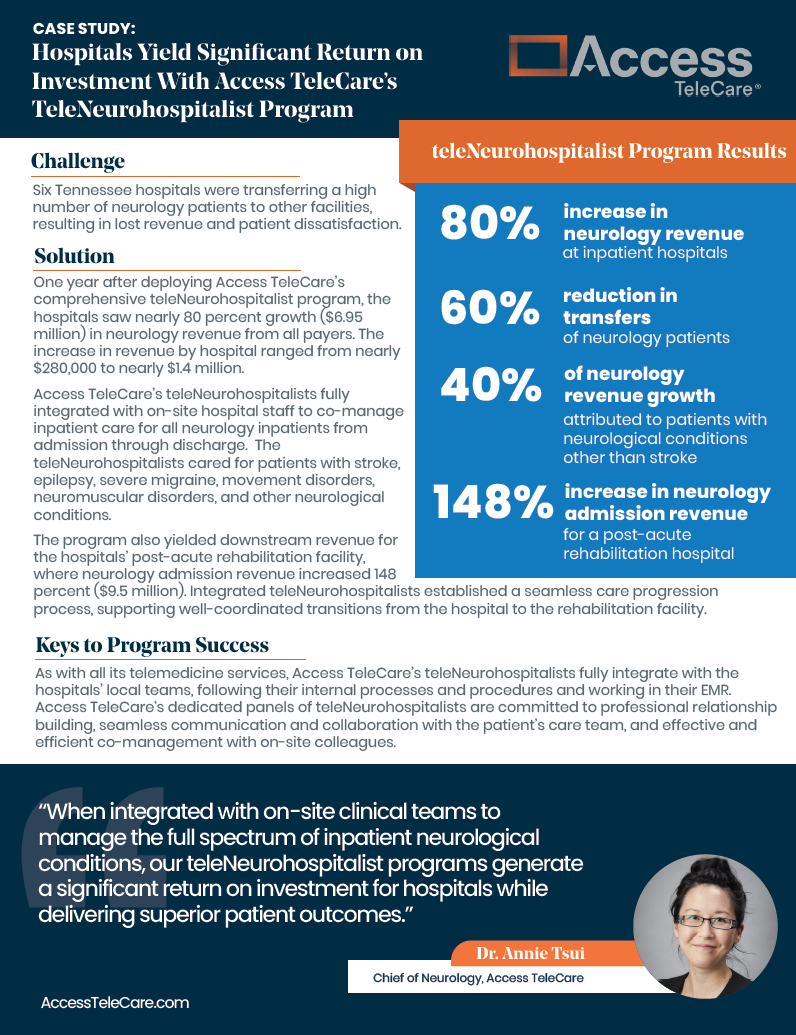
One year after deploying Access TeleCare’s comprehensive teleNeurohospitalist program, the hospitals saw nearly 80 percent growth ($6.95 million) in neurology revenue from all payers. The increase in revenue by hospital ranged from nearly $280,000 to nearly $1.4 million.
Access TeleCare’s teleNeurohospitalists fully integrated with on-site hospital staff to co-manage inpatient care for all neurology inpatients from admission through discharge. The teleNeurohospitalists cared for patients with stroke, epilepsy, severe migraine, movement disorders, neuromuscular disorders, and other neurological conditions.
The program also yielded downstream revenue for the hospitals’ post-acute rehabilitation facility, where neurology admission revenue increased 148 percent ($9.5 million). Integrated teleNeurohospitalists established a seamless care progression process, supporting well-coordinated transitions from the hospital to the rehabilitation facility.
Keys to Program Success
As with all its telemedicine services, Access TeleCare’s teleNeurohospitalists fully integrate with the hospitals’ local teams, following their internal processes and procedures and working in their EMR. Access TeleCare‘s dedicated panels of teleNeurohospitalists are committed to professional relationship building, seamless communication and collaboration with the patient’s care team, and effective and efficient co-management with on-site colleagues.