
Sustainable Specialty Coverage
Establish dependable nephrology coverage to fit your hospital’s needs.
Timely Inpatient Intervention
Provide rapid access to nephrology expertise for patients with acute kidney injury, electrolyte derangements, renal replacement therapy decisions, and other high-acuity renal conditions.
Board-Certified Clinical Expertise
Deliver consistent access to experienced nephrologists without the delays, expense, and uncertainty associated with traditional recruitment and locums models.
Reduced Avoidable
Transfers
Transfers
Retain kidney patients locally by managing complex nephrology cases in place whenever clinically feasible and
appropriate.
Dialysis Oversight & Program Supervision
Strengthen dialysis capability through structured nephrology leadership, clinical governance, and treatment oversight.
Operational and Financial Impact
Support service-line stability, improve care coordination, enhance case mix index, and preserve the value of retained renal care.
Sustainable Specialty Coverage
Establish dependable nephrology coverage to fit your hospital’s needs.
Timely Inpatient Intervention
Provide rapid access to nephrology expertise for patients with acute kidney injury, electrolyte derangements, renal replacement therapy decisions, and other high-acuity renal conditions.
Board-Certified Clinical Expertise
Deliver consistent access to experienced nephrologists without the delays, expense, and uncertainty associated with traditional recruitment and locums models.
Reduced Avoidable
Transfers
Transfers
Retain kidney patients locally by managing complex nephrology cases in place whenever clinically feasible and
appropriate.
Dialysis Oversight & Program Supervision
Strengthen dialysis capability through structured nephrology leadership, clinical governance, and treatment oversight.
Operational and Financial Impact
Support service-line stability, improve care coordination, enhance case mix index, and preserve the value of retained renal care.
How TeleNephrology Works
See how Access TeleCare delivers inpatient and outpatient nephrology consults, treatment planning and care management, dialysis supervision, and integrated specialty support through a physician-led telemedicine model designed to strengthen both clinical care and hospital operations.

“With chronic kidney disease on the rise and the nephrology workforce under increasing strain, hospitals need a more durable and clinically effective model for renal care delivery.
TeleNephrology supports hospitals and health systems in maintaining consistent specialty access, reducing avoidable transfers, and caring for more complex patients with greater continuity and confidence.”
Saurin Patel, M.D.
Chief of Hospitalist Medicine and Emerging Service Lines
Access TeleCare
Comprehensive Nephrology Support – Built for hospitals
Access TeleCare’s teleNephrology program supports hospitals, inpatient rehabilitation facilities, and outpatient settings with subspecialty consultation, dialysis program supervision, and continuity of renal care. Our nephrologists integrate directly with local physicians, clinical teams, dialysis partners, workflows, and EMRs to deliver high-acuity specialty care without operational disruption.

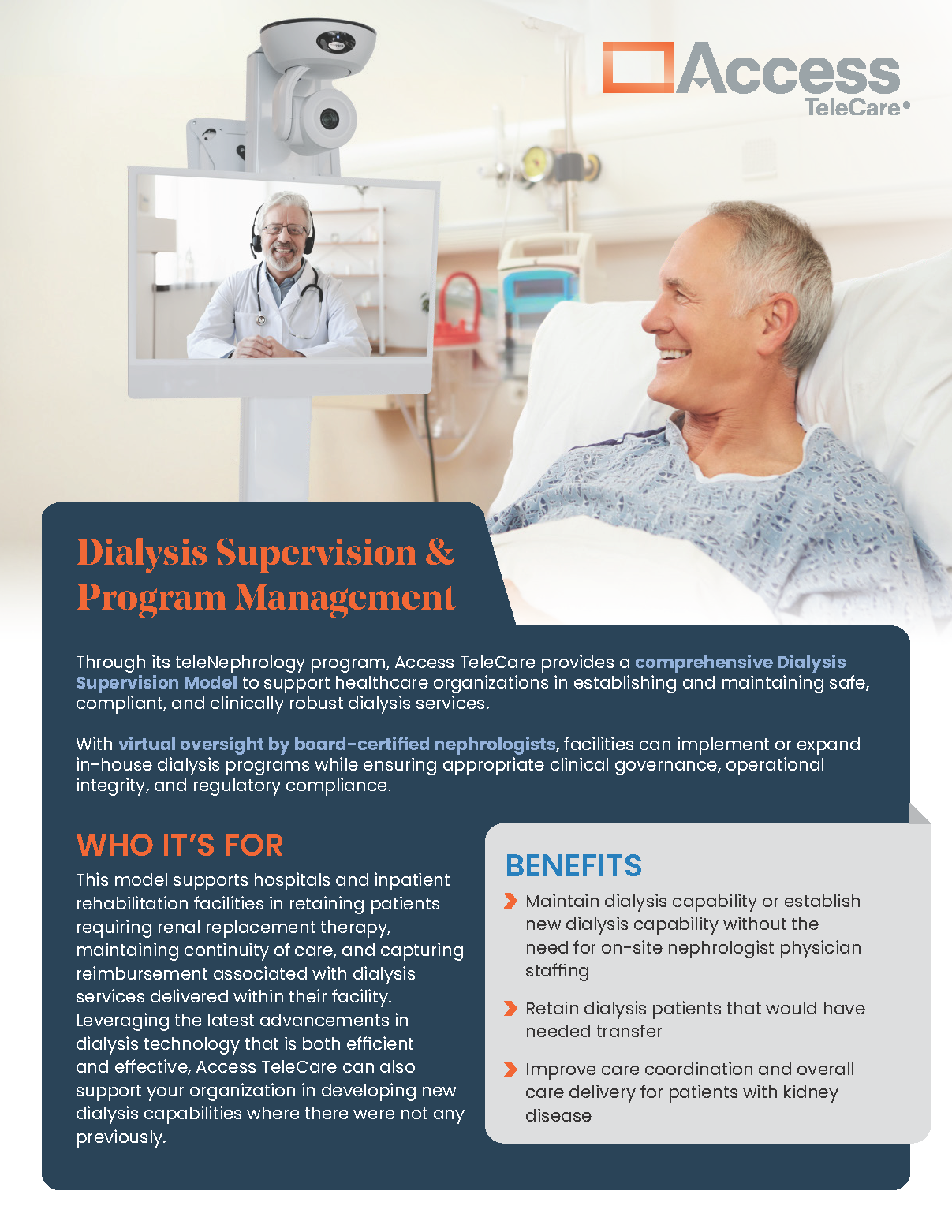
Dialysis Supervision & Program Management
With its teleNephrology program, Access TeleCare also provides a comprehensive Dialysis Supervision Model to help healthcare organizations establish, sustain, and strengthen safe, compliant, and clinically robust dialysis services.
With virtual oversight from board-certified nephrologists, hospitals and inpatient rehabilitation facilities can implement or expand in-house dialysis programs while maintaining appropriate clinical governance, operational consistency, and regulatory alignment.
This model supports facilities in retaining patients requiring renal replacement therapy, reducing external transfers, and supporting continuity of care within the same clinical environment.
TeleNephrology Services for Critical Access Hospitals’ Swing Bed Programs
Our teleNephrologists collaborate with hospitals’ local case managers, physicians, nurses,and other clinical staff to manage the post-acute hospitalization of patients needing kidney care in addition to rehabilitation services. With Access TeleCare’s teleNephrology team, CAHs can accept more patients into their swing bed programs.

Explore Case Studies

Patient Impact Story: Access TeleCare’s teleNephrology Impact
See how Access TeleCare delivered timely, local nephrology care at a community hospital, turning a concerning clinical finding into a clear diagnosis >>

Enhancing Local Nephrology Coverage
Two hospitals in the same health system faced the retirement of their sole nephrologist and needed a sustainable solution for the future.
Caring for More High-Acuity Patients Close to Home
When rural hospitals implement telemedicine, they typically have one, possibly two, service lines. This hospital in rural Texas has eight.
Frequently Asked Questions
TeleNephrology is exactly what it sounds like – a virtual nephrology care model that gives hospitals and health systems access to board-certified nephrologists through telemedicine. How Access TeleCare executes teleNephrology is what really matters. Our process supports hospitals by expanding access to renal expertise for inpatient and outpatient care, helping local teams manage kidney-related conditions without relying solely on onsite nephrologist coverage. Our teleNephrology program helps hospitals strengthen specialty access, support more complex patients locally, and improve continuity of care.
TeleNephrology can help reduce kidney patient transfers by giving hospitals timely access to nephrology expertise for evaluation, treatment planning, and ongoing management. With specialist support available remotely, hospitals can often care for more patients with renal conditions in-house rather than transferring them elsewhere for consultation or oversight. Access TeleCare’s teleNephrology works collaboratively to keep appropriate patients close to home while protecting hospital volume and reducing avoidable transfer-related disruption.
Yes. TeleNephrology programs can be structured to provide around-the-clock inpatient renal care coverage, including support for urgent and routine consults. Coverage models vary by organization, but many hospitals use teleNephrology to extend nephrology access beyond local staffing limitations, weekends, or after-hours gaps. This gives bedside teams more reliable access to renal expertise when it is needed most.
Access TeleCare’s teleNephrology program treats a wide range of renal conditions, including acute kidney injury, chronic kidney disease, end-stage renal disease, electrolyte imbalances, volume overload, and dialysis-related needs. TeleNephrologists may also help manage patients requiring emergent hemodialysis, peritoneal dialysis oversight, and renal replacement therapy planning. The exact scope depends on the hospital’s needs, patient population, and care model.
Access TeleCare’s TeleNephrology program does what many other telehealth systems don’t. Since we’re more than a technology, Access TeleCare puts world-class nephrologists at the bedside in rural hospitals virtually. When recruiting and retaining an onsite nephrologist becomes nearly impossible and cost-prohibitive, rural facilities connect their care teams with Access TeleCare’s board-certified nephrologists who support diagnosis, treatment, care planning, and dialysis oversight remotely. This helps rural hospitals strengthen local care delivery, reduce unnecessary transfers, and retain more patients in their own communities.
Access TeleCare works as a collaborative extension of the onsite care team. Our teleNephrologists coordinate with hospitalists, intensivists, surgeons, nurses, dialysis staff, case managers, and other clinicians to support patient evaluation, treatment decisions, and ongoing renal management. The goal of each nephrologist is not to function separately from the hospital team, but to integrate into existing clinical operations and support coordinated care.
Implementation timelines vary based on the hospital’s goals, technology, workflows, and coverage needs. In general, teleNephrology programs can often be launched more quickly than recruiting and onboarding an onsite nephrologist, especially in markets with ongoing specialist shortages. A strong teleNephrology partner should guide implementation planning, clinical protocols, workflow alignment, and operational readiness to support a smooth launch.
Yes. A well-designed teleNephrology program should align with a hospital’s existing EHR, documentation processes, and clinical workflows whenever possible. Access TeleCare strives to ensure each nephrologist’s treatment feels operationally seamless for physicians, nurses, and other staff rather than adding unnecessary complexity experienced in other systems. Integration is a key part that went into building Access TeleCare’s teleNephrology model that supports adoption, efficiency, and continuity of care.
TeleNephrology staffing models vary based on hospital size, patient volume, acuity, and coverage goals. Some of Access TeleCare’s partners use teleNephrology for full inpatient coverage, while others use it to augment local nephrologists, support transitional coverage, or extend access during nights, weekends, or high-demand periods. Programs are typically built around board certified nephrologists and designed to match the operational realities of the facility.
Access TeleCare’s teleNephrology specialists focus on reducing length of stay and readmissions by giving patients faster access to renal expertise, reducing delays in care planning, and supporting better coordination throughout the hospitalization. Earlier nephrology intervention helps care teams more efficiently treat renal complications and improve discharge planning for patients with ongoing kidney care needs. By implementing the program well with a highly trained and experienced teleNephrology system, your local team proactively improves clinical flow and consistent follow-up planning for better outcomes. More importantly, a local team avoids implementation mistakes that come with piecing together a program by using disparate pieces.
TeleNephrology can offer a more flexible and sustainable alternative to recruiting onsite nephrologists, especially in hard-to-staff markets. Hospitals may benefit from lower recruiting burden, more consistent specialty coverage, reduced avoidable transfers, improved retention of higher-acuity patients, and stronger support for documentation and case mix performance. For many organizations, teleNephrology is not just a coverage solution but a way to strengthen both clinical operations and financial performance.

How Telemedicine Fits Into the Healthcare Affordability Equation
Acute Care Telemedicine, Behavioral Health, Emergency Care, General Telemedicine, Infectious Disease, maternal-fetal medicine, Rural Health Care, teleCardiology, teleEEG, teleEndocrinology, teleHospitalists, teleICU, teleInfectious Disease, teleMaternal-Fetal Medicine, teleNephrology, teleNeurology, telePsychiatry, telePulmonology, teleStroke
How Telemedicine Fits Into the Healthcare Affordability Equation
By Chris Gallagher, M.D. Founder and Chief Strategy Officer, Access [...]
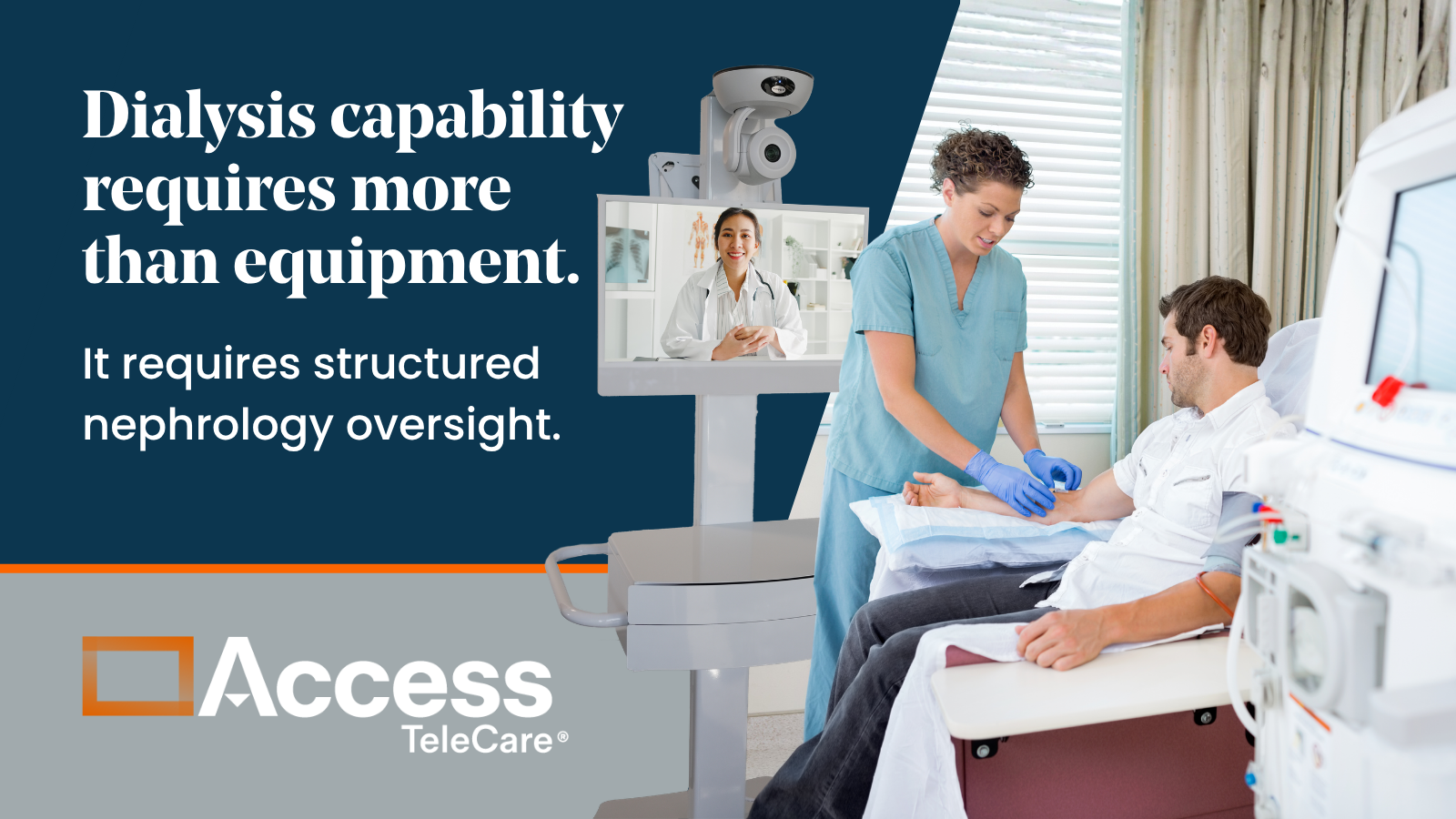
Dialysis Supervision and Program Management for Hospitals and Inpatient Rehabilitation Facilities
For hospitals and inpatient rehabilitation facilities, having reliable dialysis [...]

A More Sustainable Model for Nephrology Coverage
By Saurin Patel, M.D. Chief of Hospitalist Medicine and Emerging [...]

National Kidney Month: Strengthening Access to Nephrology Care Through Telemedicine
National Kidney Month is a reminder of the importance of [...]

The Rural Health Transformation Opportunity: How Hospitals Can Put It into Practice
Acute Care Telemedicine, Behavioral Health, Emergency Care, General Telemedicine, In The Media, Infectious Disease, maternal-fetal medicine, teleCardiology, teleEEG, teleEndocrinology, teleHospitalists, teleICU, teleInfectious Disease, teleMaternal-Fetal Medicine, teleNephrology, teleNeurology, telePsychiatry, telePulmonology, teleStroke, Trending
The Rural Health Transformation Opportunity: How Hospitals Can Put It into Practice
Rural hospitals are entering a pivotal moment. With the launch [...]

The Texas Rural Health Transformation Opportunity: How Hospitals Can Put It into Practice
Acute Care Telemedicine, General Telemedicine, Rural Health Care, teleCardiology, teleHospitalists, teleICU, teleInfectious Disease, teleMaternal-Fetal Medicine, teleNephrology, teleNeurology, telePulmonology, teleStroke
The Texas Rural Health Transformation Opportunity: How Hospitals Can Put It into Practice
Texas rural hospitals are entering a pivotal moment. With the [...]