
Key Benefits of Telemedicine for Emergency Departments
Rapid Response Times
Rapid Response Times
Psychiatric consults with guaranteed service-level agreement within 2 hours.Higher Patient Throughput
Higher Patient Throughput
Disposition patients with behavioral health needs quickly and move them to the next/appropriate care setting, opening beds for others who need them and preventing unnecessary boarding.Increase Access to Behavioral Health Care
Increase Access to Behavioral Health Care
Timely access to behavioral health care leads to better health outcomes overall for patients.Reduce Turnover and Clinical Burnout
Reduce Turnover and Clinical Burnout
Alleviate the burden and stress of 24/7 psychiatric patient care from your on-site staff leveraging Access TeleCare’s clinicians.Timely Access to Virtual Behavioral Health Experts
We guarantee rapid response times, helping to quickly move psychiatric patients to the next/appropriate care setting preventing unnecessary boarding. Access TeleCare works within your EMR to document and deploy behavioral health services in close collaboration with your care teams.
We expand behavioral health access to meet your emergency departments growing mental health needs with efficient, high-quality care delivery.

Access TeleCare Helps Hospitals Overcome Their Toughest Challenges
In this webinar, two industry veterans and innovators explored firsthand experiences and successful strategies in deploying telemedicine solutions to overcome challenges such as access to care, timeliness of care, and workforce issues, with a special focus on behavioral health and neurology programs.
Accelerate Emergency Throughput With Telemedicine
With Access TeleCare, hospitals have the ability to more quickly move patients through their emergency departments to the advantage of patients and emergency department care teams.
Improving Behavioral Health Access for Children & Adolescents
Dr. John Kenny, Access TeleCare’s chief of psychiatry, discusses the imperative for addressing children’s mental health needs and how we helped one 10-year child get an accurate diagnosis of OCD that was causing intrusive thoughts of harming another person.
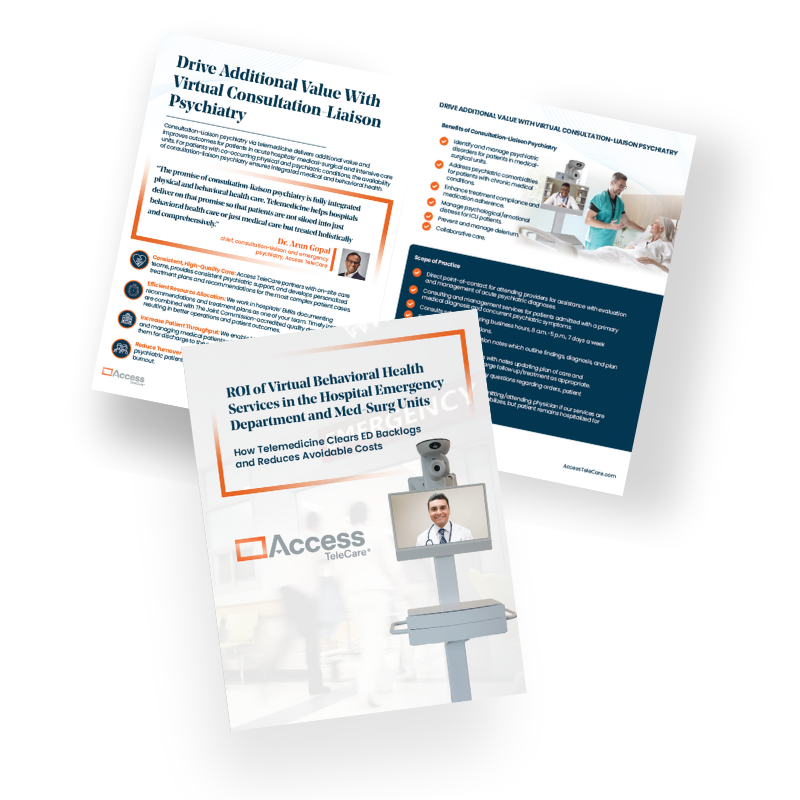
ROI of Virtual Behavioral Health Services in the Hospital Emergency Department and Med-Surg Units
Read the whitepaper to discover how Access TeleCare’s behavioral health programs clear emergency department backlogs and reduce unnecessary costs.
Access TeleCare’s teleBehavioral Health programs help hospitals achieve significant results:
Achieved annual ROI of
281 percent
Reduced LOS for behavioral health patients by
70 percent
Avoided annualized boarding costs of more than
$1.7 million
Reduced transfer rates to
9 percent
Increased revenue by 80 percent
Decreased outbound neurology transfers by 60 percent
Increased Medicare neurology inpatient admissions 79 percent
See how TeleBehavioral Health helped one hospital reduce length of stay and increase ROI by 281%.
Fill out the form below to download the whitepaper.
How Telemedicine Works
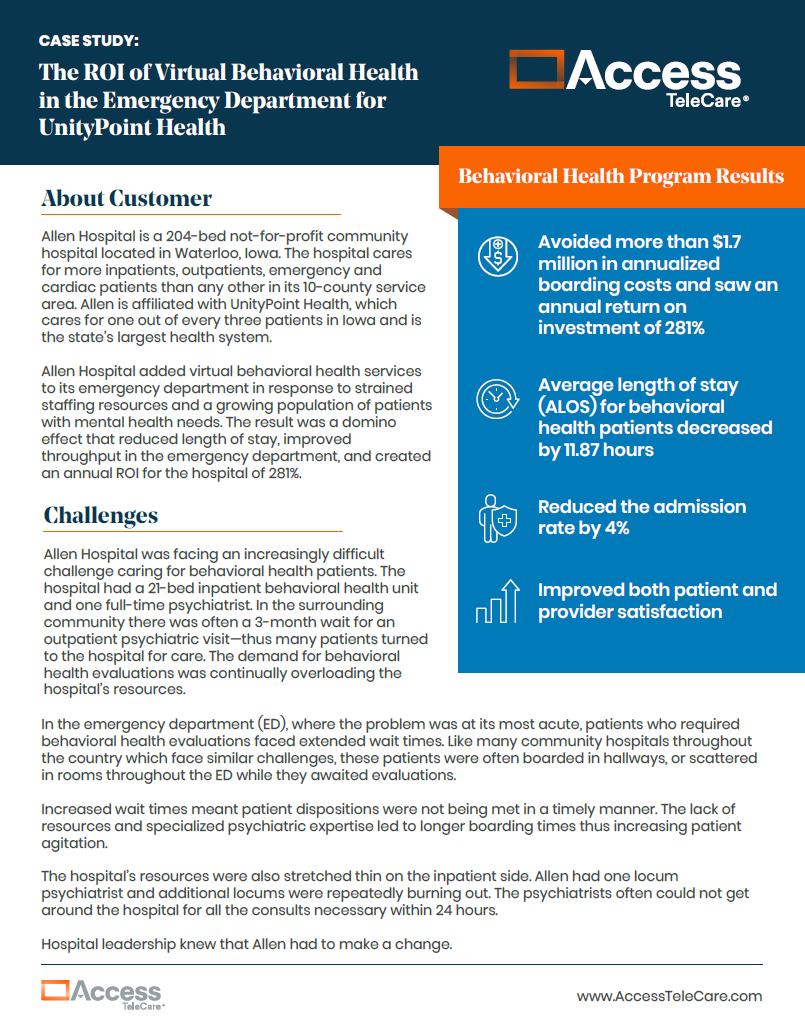
The ROI of Virtual Behavioral Health in the Emergency Department
Allen Hospital was facing an increasingly difficult challenge caring for behavioral health patients in its 21-bed inpatient behavioral health unit, which had just one full-time psychiatrist. See how Access TeleCare’s three-pronged approach alleviated the hospital’s staffing challenges and produced significant results for the hospital and its patients.
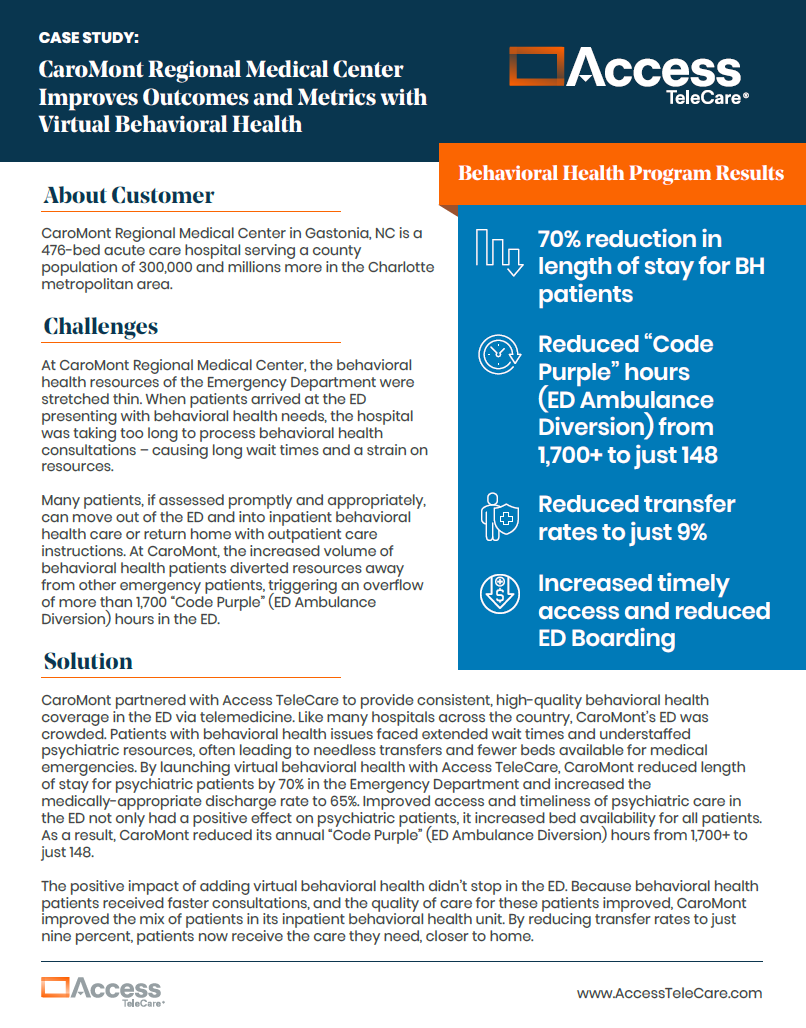
CaroMont Regional Medical Center Improves Outcomes and Metrics with Virtual Behavioral Health
Access TeleCare helped CaroMont Regional Medical Center, a 476-bed acute care hospital in North Carolina, see patients presenting to the ED with behavioral health needs quickly, reducing transfers, ED boarding times, and length of stay.
Virtual Behavioral Health Across the Continuum of Care




The Latest in Behavioral Health

How telePsychiatry solves psychiatry staffing challenges for psychiatric patients and patients with comorbid conditions
A hospital in a region with a shortage of psychiatric [...]

Tomorrow’s Hospital Leaders Are Already Looking at Behavioral Health in the ED
Behavioral health demand is becoming one of the next defining [...]

How Telemedicine Fits Into the Healthcare Affordability Equation
Acute Care Telemedicine, Behavioral Health, Emergency Care, General Telemedicine, Infectious Disease, maternal-fetal medicine, Rural Health Care, teleCardiology, teleEEG, teleEndocrinology, teleHospitalists, teleICU, teleInfectious Disease, teleMaternal-Fetal Medicine, teleNephrology, teleNeurology, telePsychiatry, telePulmonology, teleStroke
How Telemedicine Fits Into the Healthcare Affordability Equation
By Chris Gallagher, M.D. Founder and Chief Strategy Officer, Access [...]
Frequently Asked Questions
Access TeleCare helps reduce ED boarding times for psychiatric patients by accelerating access to psychiatric evaluation and disposition planning. The service gives emergency departments a consultation response within two hours, helping care teams avoid waiting for limited onsite psychiatric availability. Access TeleCare clinicians evaluate the patient, document recommendations in the hospital EMR, and conduct peer-to-peer communication with the requesting physician. Faster psychiatric input can help determine whether the patient needs inpatient placement, transfer, outpatient follow-up, or another appropriate care pathway. Boarding times can often still depend on bed availability, hospital workflow, and community resources – but when it comes down to the patient needing to get rapid access to high-quality psychiatric care – Access TeleCare can help.
Access TeleCare helps hospitals address emergency behavioral health staffing shortages by giving ED teams access to virtual psychiatric clinicians without relying only on onsite psychiatrist availability. The service provides 24/7/365 consultation coverage with guaranteed response times, helping hospitals support behavioral health patients during nights, weekends, holidays, and surge periods. Access TeleCare clinicians evaluate patients, document in the hospital EMR, collaborate with ED physicians, and help determine the next appropriate care setting. This model can reduce the burden on onsite staff while giving hospitals a more scalable way to manage growing behavioral health demand in the emergency department.
Access TeleCare clinicians document virtual psychiatric evaluations within the hospital EMR as part of the ED consult workflow. Documentation may include the psychiatric assessment, diagnosis review, risk considerations, medication recommendations, disposition recommendation, follow-up needs, and admission orders when inpatient placement is required. Access TeleCare clinicians also complete peer-to-peer communication with the requesting physician and sign off on the case. This EMR integration keeps psychiatric recommendations visible to the ED team and supports coordination across physicians, nurses, social workers, case managers, and receiving care settings.
Yes. Access TeleCare supports emergency departments during nights, weekends, and high-volume periods with 24/7/365 virtual psychiatric coverage. This gives ED teams access to behavioral health clinicians when onsite psychiatric resources are limited, unavailable, or stretched by patient volume. Access TeleCare’s rapid-response model helps care teams continue psychiatric evaluations, medication reviews, risk assessments, and disposition planning outside standard business hours. The service can reduce pressure on ED physicians and nurses while helping hospitals maintain a more consistent behavioral health response for patients who present in crisis at any time.
Access TeleCare can evaluate a wide range of behavioral health presentations in the emergency department, including suicidal ideation, self-harm concerns, severe anxiety or depression, psychosis, mania, agitation, substance-related crises, behavioral dysregulation, and medication-related concerns. Consultations can also support crisis response, risk assessment, safety planning, medication guidance, and disposition planning. Final suitability for a virtual psychiatric evaluation depends on the patient’s condition, hospital protocols, and safety considerations. Access TeleCare’s role is to give ED teams timely psychiatric expertise when behavioral health needs affect care, safety, or placement decisions.
Access TeleCare clinicians collaborate with ED physicians and care teams by working directly within the hospital’s established behavioral health consult workflow. After the ED team requests a consultation, the Access TeleCare clinician reviews the patient chart, conducts the virtual psychiatric evaluation, documents recommendations in the EMR, and completes peer-to-peer communication with the requesting physician. Nurses help coordinate the telemedicine encounter at the bedside, while social workers, case managers, and other team members may help with safety planning, placement, or follow-up. This model keeps psychiatric expertise connected to the ED’s clinical decision-making process.
Access TeleCare can help emergency departments reduce unnecessary psychiatric admissions and transfers by providing timely psychiatric assessment and disposition recommendations. Not every behavioral health patient who presents to the ED requires inpatient psychiatric placement or transfer. Access TeleCare clinicians evaluate the patient, assess safety concerns, review diagnoses and medications, and collaborate with the ED physician to determine the most appropriate next step. When clinically appropriate, this may support discharge planning, outpatient follow-up, or continued stabilization in the current setting. Many times, simply the expertise of the right psychiatric medications provided at the right dosage can radically improve the patient’s disposition and help care teams provide care for comorbid conditions. When inpatient care or transfer is needed, the consultation helps the care team move that process forward with clearer documentation.
Access TeleCare helps hospitals improve behavioral health patient throughput in the ED by giving care teams timely psychiatric evaluation, medication guidance, and disposition support. Instead of holding patients while waiting for onsite psychiatric availability, ED teams can request an Access TeleCare consultation and receive recommendations within the 2-hour service-level timeframe. Access TeleCare clinicians help identify the next appropriate care setting, whether that is discharge with follow-up, inpatient placement, transfer, or additional stabilization. This supports faster clinical decision-making, helps open ED beds for other patients, and reduces unnecessary boarding when clinically appropriate.
Emergency departments mobilize an Access TeleCare psychiatric consultation within a two-hour service-level agreement after the consult is requested through the 24/7/365 web portal. The Access TeleCare clinician receives the booking notification, logs into the hospital EMR, reviews the patient chart, and joins the telehealth session. The clinician then conducts the virtual behavioral health consultation and documents disposition and medication recommendations in the hospital EMR. This rapid-response model is designed for ED workflows where psychiatric evaluation, treatment recommendations, and placement decisions need to move quickly.
TelePsychiatry for emergency departments connects ED patients and staff with licensed psychiatric clinicians via secure video to support psychiatric evaluations, crisis response, risk assessments, medication guidance, and disposition planning — in under two hours. Access TeleCare’s integrated approach reduces ED boarding times, length of stay, and operational costs improving patient flow and patient and staff experience.
Access TeleCare supports behavioral health patients in the emergency department by providing 24/7/365 virtual psychiatric consultations with rapid response times. When the ED team identifies a patient who needs behavioral health evaluation, hospital staff request an Access TeleCare consult through TelemedIQ. The Access TeleCare clinician reviews the chart in the hospital EMR, joins the telehealth session, evaluates the patient, reviews diagnoses and medication needs, and provides disposition recommendations. This gives ED teams timely psychiatric expertise to support crisis response, risk assessment, medication guidance, and movement to the next appropriate care setting.
- At Access TeleCare, privacy and documentation in telePsychiatry are managed through a combination of strict HIPAA compliance, high-level data security certifications, and integrated clinical workflows. Access TeleCare adheres to all state and federal privacy laws including theHealth Insurance Portability and Accountability Act (HIPAA) ensuring that protected health information (PHI) is kept private and used only for permitted purposes like treatment or billing.
- Access TeleCare has also earned and maintained HITRUST certification for their telemedicine platform, Telemed IQ, and telemedicine cart infrastructure and environment.
- All of Access TeleCare’s clinicians perform documentation within the hospital or health systems EMR as well as within our HIPAA Compliant, HITRUST Certified telemedicine platform, Telemed IQ.
- Additionally, Access TeleCare is the standard bearer of clinical excellence in telemedicine, maintaining an active accreditation as a Patient Safety Organization with the Agency for Healthcare Research and Quality (AHRQ), along with ongoing internal quality reviews and F/OPPEs with clinician peer review and ongoing documentation monitoring processes.
Access TeleCare uses a secure, HIPAA-compliant video platform, a dedicated device, reliable internet connectivity, and a defined workflow for consult activation, documentation, and handoffs. A hospital may use an Access TeleCare device or a third-party device to connect with the virtual psychiatric clinicians.
TelePsychiatry clinicians collaborate with ED physicians, nurses, social workers/case managers, and other staff to align on assessment findings, safety planning, medication considerations, and next-step placement or follow-up care. Access TeleCare’s pods of specialists operate like in-person clinicians and become an integrated part of staffing and operations. On-site teams know which psychiatric clinicians are on call and who is responsible for patient encounters and treatment management.
TelePsychiatry can support evaluation and treatment planning for patients with a wide range of behavioral health presentations, including suicidal ideation, depression, anxiety, psychosis, mania, substance use-related concerns, and behavioral dysregulation. Final suitability is determined by a hospital’s clinical protocols and patient safety considerations.
Many ED telepsychiatry programs, like Access TeleCare, are designed for 24/7 coverage to help address nights, weekends, and surge periods. As with all Access TeleCare telemedicine specialty programs, telePsychiatry is available 24/7 for emergency departments if that meets the hospital needs. Our models are designed to be flexible to meet specialty coverage needs of any duration.
By providing faster access to psychiatric evaluations and treatment recommendations, telePsychiatry accelerates clinical decision-making and disposition planning, which reduces time-to-evaluation and support smoother transfers to an inpatient setting or appropriate outpatient pathways when clinically appropriate. Because virtual psychiatric consultation is available quickly, patients are not left boarding while waiting for in-person psychiatry to be free.
Access TeleCare’s acute behavioral health virtual care integrates with local ED teams to rapidly respond to patient needs through on-demand assessment and treatment support for patients experiencing a behavioral health crisis in the ED, including suicidality, severe anxiety or depression, psychosis, substance-related crises, and agitation.