
Virtual Behavioral Health Services for Medical-Surgical & Intensive Care Units
Professional psychiatric coverage with same day and next day scheduled appointments for behavioral health consultations.
Access TeleCare provides medical-surgical and intensive care units with professional psychiatric coverage for behavioral health consultations. With Access TeleCare’s virtual behavioral health platform, you can provide psychiatric consultations with same day and next day scheduled appointments.
Key Benefits of Telemedicine for Med-Surg & ICU
Rapid Response Times
Rapid Response Times
Psychiatric consults with same/next day scheduled appointments for Med-Surg & Intensive Care Units.
Higher Patient Throughput
Higher Patient Throughput
Stabilize and manage medical patients with behavioral health conditions and prepare them for discharge to the next appropriate care setting.
Increase Access to Behavioral Health Care
Increase Access to Behavioral Health Care
More timely access to behavioral health care leads to better health outcomes overall for patients.
Reduce Turnover and Clinical Burnout
Reduce Turnover and Clinical Burnout
Alleviate the burden and stress of psychiatric patient care from your on-site staff leveraging Access TeleCare’s clinicians.
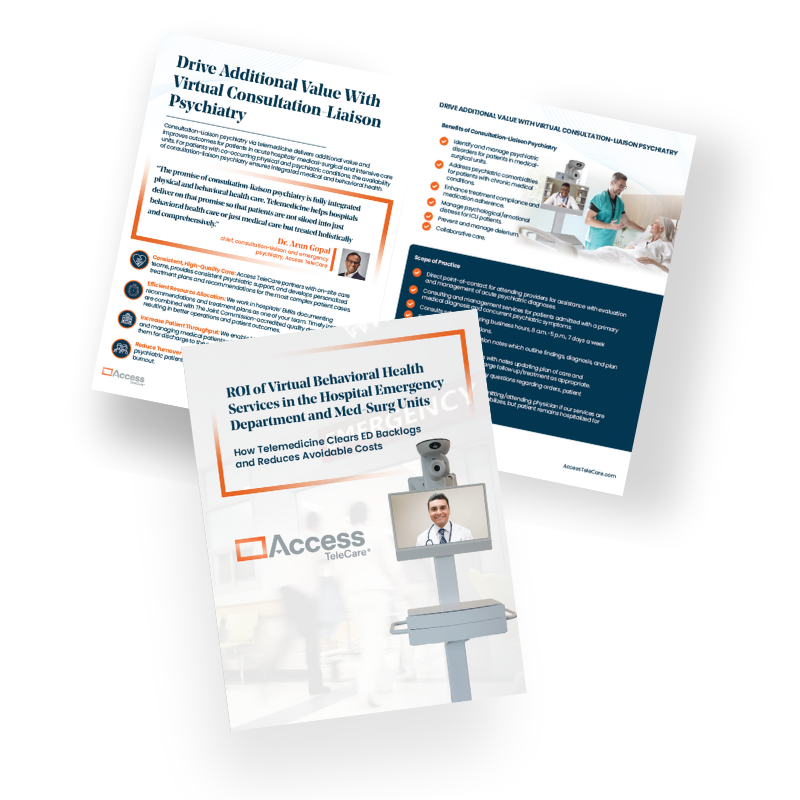
ROI of Virtual Behavioral Health Services in the Hospital Emergency Department and Med-Surg Units
Read the whitepaper to discover how Access TeleCare’s behavioral health programs clear emergency department backlogs and reduce unnecessary costs.
Access TeleCare’s teleBehavioral Health programs help hospitals achieve significant results:
Achieved annual ROI of
281 percent
Reduced LOS for behavioral health patients by
70 percent
Avoided annualized boarding costs of more than
$1.7 million
Reduced transfer rates to
9 percent
Increased revenue by 80 percent
Decreased outbound neurology transfers by 60 percent
Increased Medicare neurology inpatient admissions 79 percent
See how TeleBehavioral Health helped one hospital reduce length of stay and increase ROI by 281%.
Fill out the form below to download the whitepaper.
Meet Your Community’s Mental Health Needs
In order to meet the demands of more medically complicated conditions, Access TeleCare’s telemedicine services offer consultation-liaison psychiatry services. Our consultation-liaison approach specializes in the diagnosis and management of psychiatric disorders that are comorbid with general medical/surgical illness.
Access TeleCare providers work within your EMR to document and deploy behavioral health services in close collaboration with your care teams. We expand behavioral health access to meet your care teams growing mental health needs with efficient, high-quality care delivery.


Consultation-Liaison Psychiatry
In medically complex situations, providing comprehensive and integrated psychiatric care to patients is paramount. Medical-surgical units and intensive care units often witness patients facing significant physical and emotional challenges. This is where the invaluable role of consultation-liaison psychiatry comes into play. At Access TeleCare, we recognize the importance of delivering consultation-liaison psychiatry services within these units, and we will work closely with your team to develop a care program that enhances patient care and outcomes.
To learn more about our approach to consultation-liaison psychiatry, read this blog: Enhancing Patient Care: Consultation-Liaison TelePsychiatry in Acute Care Settings.
How it Works
Virtual Behavioral Health Across the Continuum of Care





Access TeleCare Helps Hospitals Overcome Their Toughest Challenges
In this webinar, two industry veterans and innovators explored firsthand experiences and successful strategies in deploying telemedicine solutions to overcome challenges such as access to care, timeliness of care, and workforce issues, with a special focus on behavioral health and neurology programs.
The Latest in Behavioral Health

How telePsychiatry solves psychiatry staffing challenges for psychiatric patients and patients with comorbid conditions
A hospital in a region with a shortage of psychiatric [...]

Tomorrow’s Hospital Leaders Are Already Looking at Behavioral Health in the ED
Behavioral health demand is becoming one of the next defining [...]

How Telemedicine Fits Into the Healthcare Affordability Equation
Acute Care Telemedicine, Behavioral Health, Emergency Care, General Telemedicine, Infectious Disease, maternal-fetal medicine, Rural Health Care, teleCardiology, teleEEG, teleEndocrinology, teleHospitalists, teleICU, teleInfectious Disease, teleMaternal-Fetal Medicine, teleNephrology, teleNeurology, telePsychiatry, telePulmonology, teleStroke
How Telemedicine Fits Into the Healthcare Affordability Equation
By Chris Gallagher, M.D. Founder and Chief Strategy Officer, Access [...]
Frequently Asked Questions
Hospitals use Access TeleCare’s teleBehavioral Health service for patients receiving medical or critical care to evaluate behavioral health symptoms and psychiatric comorbidities that may affect the patient’s treatment, recovery, safety, or discharge plan. The clinician reviews the medical record, conducts a virtual psychiatric consultation, provides treatment and medication recommendations, and communicates directly with the hospital care team. Access TeleCare offers same-day and next-day scheduled consultations, helping hospitals add psychiatric capacity without requiring an onsite psychiatrist to be continuously available.
Med-Surg or ICU teams can request an Access TeleCare psychiatric consultation when behavioral health symptoms complicate a patient’s medical care, recovery, safety, or discharge plan. Common reasons may include new or worsening psychiatric symptoms, agitation, psychosis, depression, anxiety, self-harm concerns, substance-related concerns, questions about decision-making capacity, or the need to review psychiatric medications during an acute illness. Consultations may also help when a patient’s behavioral health needs could affect treatment adherence, placement, or readiness for discharge. The local medical team determines when psychiatric expertise would support the patient’s overall care plan.
Yes. Access TeleCare provides consultation-liaison psychiatric support for medically complex Med-Surg and ICU patients who also have behavioral health conditions. Its clinicians evaluate psychiatric symptoms in the context of the patient’s medical diagnoses, current treatment, medication regimen, and overall clinical condition. They then collaborate with hospitalists, intensivists, nurses, case managers, and other members of the local care team to develop recommendations that support both medical and behavioral health needs. This coordinated approach helps hospitals manage appropriate patients in their current care setting while preparing them for discharge or the next appropriate level of care.
Access TeleCare clinicians work within the hospital’s EMR to review relevant clinical information and document the psychiatric consultation. Depending on the hospital’s program and workflow, documentation may include the psychiatric assessment, clinical findings, medication recommendations, risk considerations, care plan, follow-up needs, and recommendations for discharge or placement. The Access TeleCare clinician can also communicate directly with the requesting physician and other members of the care team. This integration keeps psychiatric recommendations in the same clinical record used by onsite teams and allows Access TeleCare to function as an extension of the hospital’s care delivery capabilities.
Yes. Access TeleCare clinicians can review a Med-Surg or ICU patient’s psychiatric medication regimen as part of the virtual consultation. The clinician considers the patient’s behavioral health symptoms, psychiatric history, current medications, medical diagnoses, and acute clinical condition before providing recommendations to the local care team. This may include evaluating whether existing psychiatric medications remain appropriate, identifying possible medication-related concerns, or recommending changes for the treating medical team to consider. Medication decisions remain coordinated with the hospitalists, intensivists, nurses, pharmacists, and other clinicians managing the patient’s overall medical care.
Access TeleCare helps prepare patients for discharge or inpatient placement by providing a timely psychiatric assessment and clear recommendations for the next appropriate care setting. Its clinicians can evaluate current behavioral health symptoms, treatment needs, medication considerations, safety concerns, and follow-up requirements. They document their recommendations in the hospital’s EMR and collaborate with physicians, nurses, case managers, and discharge planners. This information can help the local team determine whether a patient can safely discharge with outpatient follow-up, remain in the current setting, or requires transfer or admission to an inpatient behavioral health program.
Access TeleCare’s Med-Surg and ICU consultations can address psychiatric concerns that affect a patient’s medical treatment, safety, recovery, or disposition. These may include depression, anxiety, agitation, psychosis, self-harm concerns, substance-related symptoms, preexisting psychiatric conditions, questions about decision-making capacity, and psychiatric medication concerns. Access TeleCare clinicians can also help clarify behavioral symptoms when medical and psychiatric factors overlap. The consultation is tailored to the patient’s clinical situation, with recommendations communicated directly to the physicians, nurses, case managers, and other onsite clinicians responsible for the patient’s care.
Access TeleCare’s teleBehavioral Health clinicians collaborate directly with nurses, hospitalists, intensivists, case managers, and other members of the onsite care team. Hospital staff identify the need for a consultation and help coordinate the virtual encounter. The Access TeleCare clinician reviews the patient’s chart, conducts the psychiatric assessment, discusses findings with the requesting team, and documents recommendations in the hospital’s EMR. Nurses can provide important bedside observations, while hospitalists and intensivists contribute medical context and remain responsible for the patient’s broader treatment. This collaborative model integrates psychiatric expertise into the patient’s existing medical care plan.
Yes. Access TeleCare offers same-day and next-day scheduled psychiatric consultations for Med-Surg and ICU patients, helping hospitals avoid waiting for limited onsite psychiatric availability. Timely access allows the medical team to address psychiatric symptoms, medication questions, safety concerns, and disposition needs while the patient continues receiving medical care. Access TeleCare clinicians review the chart, evaluate the patient virtually, document recommendations in the EMR, and collaborate with the onsite team. This can help prevent psychiatric consultation delays from becoming a barrier to treatment planning, discharge, or movement to the next appropriate care setting.
Access TeleCare’s psychiatric consultations may help hospitals avoid unnecessarily prolonged sitter use by providing timely assessment of a patient’s behavioral health symptoms, particularly in medically complex situations where timely consultation is of the utmost importance. The psychiatric clinician can give the local team recommendations that fit within the broader complex medical scenario supporting decisions about precautions, treatment, and the need for continued one-to-one observation.
Access TeleCare provides same-day and next-day scheduled psychiatric consultations for patients in Med-Surg and ICU units. Typically, these are scheduled out as routine follow-ups across the unit, and the care is provided consistently until discharge. The hospital requests the consultation according to its established Access TeleCare workflow, allowing the virtual clinician to review the patient’s chart, conduct the assessment, document recommendations, and collaborate with the onsite care team. Response time depends mostly on the hospital’s coverage model, consultation schedule, and the workflow established with the hospital that best fits their needs.
Access TeleCare’s telePsychiatry service can help reduce avoidable delays that may extend a Med-Surg patient’s hospital stay. Same-day and next-day psychiatric consultations give care teams timely recommendations regarding behavioral health treatment, medications, safety needs, discharge readiness, and placement. This can help physicians, nurses, case managers, and discharge planners move the patient toward the next appropriate care setting without waiting for onsite psychiatric availability. It can also provide needed psychiatric support and medication to help settle patients and enable other care to occur without disruption, easing the burden for the patient and the on-site care team.