
Pulmonology and Critical Care Support Across the Patient Journey
teleICU and Critical Care
Give bedside teams access to experienced critical care physicians for scheduled rounds, urgent consultations, ventilator management, treatment planning, and ongoing management of critically ill patients in the ICU.

A Program, not a One-Time Consultation
“A successful telePulmonology and Critical Care program is not a one-and-done consult. We follow patients day to day, coordinate with the bedside team, and help hospitals build the clinical capability to care for more complex patients.”
Pritam Ghosh, M.D.
Chief Medical Officer, Medical Group President
Access TeleCare
Strengthen Clinical, Operational, and Financial Performance




How telePulmonology and Critical Care Works
See How telePulmonology and Critical Care Builds Hospital Capacity
Access TeleCare helps hospitals build sustainable pulmonology and critical care programs, coordinate care across multidisciplinary teams, and strengthen their ability to care for complex patients locally.
Building 24/7 Pulmonary and Critical Care Access
Palo Pinto General Hospital in rural Texas partnered with Access TeleCare during the height of the COVID-19 pandemic to provide around-the-clock pulmonology and critical care coverage and strengthen its ability to care for higher-acuity patients locally.
Through the telePulmonology and Critical Care program, Access TeleCare’s board-certified specialists collaborate with the hospital’s on-site team to support ICU care, manage complex pulmonary and respiratory conditions, and guide decisions about patient retention and transfer.
“With the Access TeleCare partnership, we are enhancing the level of care provided at Palo Pinto General Hospital. We have 24/7, 365 days a year telePulmonary and Critical Care coverage so we can keep more patients closer to home and improve access to care.”
Ross Korkmas
Chief Executive Officer
Palo Pinto General Hospital
Depending on the case, that collaboration may include:
Access TeleCare’s Virtual ICU Program in Action
Dr. Pritam Ghosh, Access TeleCare Chief Medical Officer, and Carrie Tressler, VP of Nursing for Rush Memorial Hospital, discuss the benefits and results of the hospital’s virtual ICU service with Access TeleCare.
Extend Pulmonology Access Beyond the Hospital Stay
Access TeleCare also supports outpatient clinics with initial pulmonary evaluations and post-hospitalization, follow-up and ongoing care.
Patients may receive virtual care for:
- Chronic obstructive pulmonary disease
- Severe asthma
- Pulmonary fibrosis
- Pulmonary hypertension
- Long-term respiratory symptoms
- Post-hospital pulmonary follow-up
- Other chronic and complex lung conditions
Outpatient pulmonology can improve timely post-discharge follow-up and treatment compliance and expand local access where in-person pulmonology appointments are limited.
Looking for Cardiac Arrest Support?
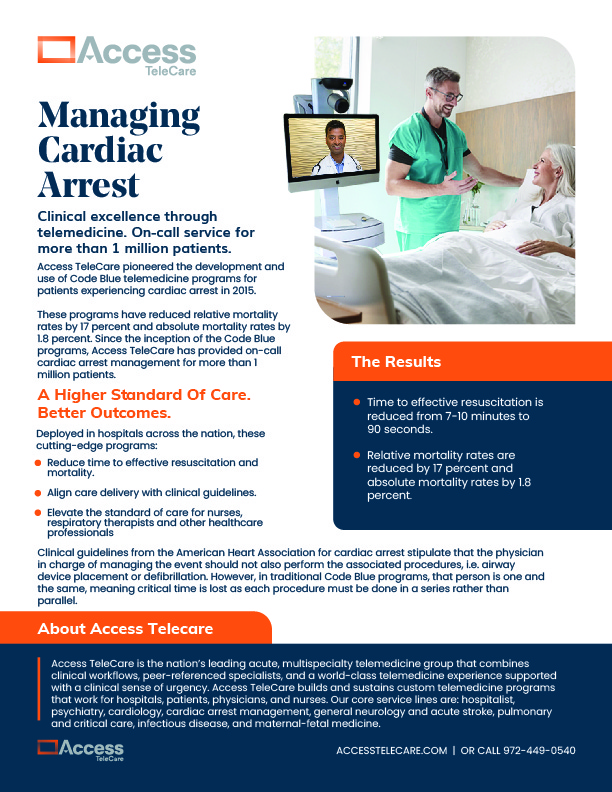
Access TeleCare’s Cardiac Arrest and Code Blue program gives hospital teams immediate access to experienced physicians during high-risk resuscitation events.
Our team pioneered the development and use of Code Blue telemedicine programs for patients experiencing cardiac arrest in 2015. This service line is staffed by highly trained physicians who are comfortable in intense situations requiring patient resuscitation.
These programs have reduced relative mortality rates by 17 percent and absolute mortality rates by 1.8 percent. Since the inception of the Code Blue programs, our team has provided on-call cardiac arrest management for more than 1 million patients.
Explore Case Studies

How Virtual Critical Care Saved a Young Mother’s Life
How Access TeleCare’s telePulmonology and Critical Care coverage helped stabilize a young mother for safe transfer.
Rapid Critical Care Intervention via Telemedicine Avoids Transfer and Achieves Positive Outcome
See how Access TeleCare’s rapid virtual ICU response stabilized a critical GI bleed patient, avoided intubation and transfer, and achieved a safe recovery. Explore The Case Study Here >> […]

Partnering to Deliver Consistent Specialty Care
Learn how one regional health system expanded specialty care with Access TeleCare, increasing neurology revenue, reducing transfers, and improving care across five hospitals.
A North Carolina Regional Medical Center’s Transition to a Virtual ICU
Learn how a North Carolina regional medical center reduced ICU transfers by 15%, retained $1.18 million in revenue, and achieved a 257% ROI with Access TeleCare's virtual ICU program.

Piggott Health System
Access TeleCare helped the Piggott team shape how rural access to specialty care heightens trust in the local care team and the hospital’s reputation.

Meeting Complex Needs Locally
Learn how Palo Pinto General Hospital expanded pulmonary and critical care locally through Access TeleCare, reducing transfers and strengthening patient care close to home.
Complex Care Coordination with Telemedicine
A morbidly obese patient with multiple conditions received coordinated care in real-time from Access TeleCare pulmonologist and infectious disease specialists. Explore The Case Study Here >>
Caring for More High-Acuity Patients Close to Home
When rural hospitals implement telemedicine, they typically have one, possibly two, service lines. This hospital in rural Texas has eight.
Frequently Asked Questions
A virtual ICU programwith Access TeleCareconnects bedside teams with remoteintensivists andpulmonary critical care specialists who can help manage unstable, complex, and high-acuity patients.TheteleICUteam can support proactive rounding, urgent consultations, transfer decisions, ventilationmanagement, treatment planning, and ICU care coordination. This helps hospitals provide a higherlevel of care without depending entirely on onsite intensivist coverage.
Yes.Access TeleCare’stelePulmonary and critical care specialists can support patients with respiratoryfailure, including those requiring mechanical ventilation. They work with onsite physicians, nurses,respiratory therapists, and other clinicians to guide ventilator management, evaluate changes inpatient status, support care planning, and determine whether the patient can be safely managedlocally or needs transfer to a higher level of care.
Access TeleCare’s telePulmonary care helps hospitals retain ICU patients locally by giving bedside teams access to specialty expertise for complex pulmonary and critical care cases. With virtual intensivist support, hospitals can manage more high-acuity patients, reduce unnecessary transfers, strengthen ICU performance, and keep patients closer to their families and community when clinically appropriate. In one Access TeleCare case study, a hospital reduced transfers by 15 percent, retained 144 additional patients annually, and achieved a 257 percent estimated ROI after implementing telePulmonary and Critical Care coverage.
Outpatient telePulmonology through Access TeleCare can support patients with chronic and complex lung conditions, including COPD, severe asthma, pulmonary fibrosis, long COVID, sleep-related breathing concerns, pulmonary hypertension, and other respiratory health needs. Patients can receive initial evaluations, follow-up visits, medication guidance, and ongoing pulmonary care through a virtual specialist visit coordinated with the local clinic or hospital team.
Access TeleCare’s teleCritical Care services give bedside teams immediate access to critical care specialists for complex ICU decision-making. TeleIntensivists can help evaluate deteriorating patients, guide clinical interventions, support nurses and respiratory therapists, assist with procedures, lead or advise during emergencies, and communicate with patients or families when difficult care decisions are needed. This model also supports staff education by giving onsite teams regular access to experienced intensivists.
A teleICU program with Access TeleCare can improve outcomes by helping care teams identify deterioration earlier, standardize ICU protocols, support timely interventions, reduce ventilator days, improve compliance with core quality measures, and make more informed admit-versus-transfer decisions. Access TeleCare also reports that its Code Blue telemedicine programs have reduced relative mortality rates by 17 percent and absolute mortality rates by 1.8 percent for cardiac arrest management. For a deeper dive on how one hospital set up a virtual ICU in partnership with Access TeleCare, watch this webinar with Access TeleCare Chief Medical Officer Dr. Pritam Ghosh and the Carrie Tressler, Rush Memorial Hospital vice president of nursing. See more in this article, featured in Healthcare IT News.
Yes. Access TeleCare’s pulmonary and critical care model can support urgent ICU and emergency needs, and its dedicated Code Blue telemedicine program is designed for cardiac arrest management. In these situations, virtual physicians can join quickly, guide resuscitation support, assist the onsite team in real time, and help manage intense, time-sensitive clinical events.
Access TeleCare’s teleCritical Care technology typically requires a secure telemedicine platform, hospital-approved video technology, access to relevant clinical information, and workflows that allow virtual specialists to communicate directly with onsite teams. Access TeleCare’s model does not require every ICU bed to be wired like a traditional eICU bunker model. Instead, virtual intensivists and pulmonologists can provide ICU, emergency, and floor-based support through telemedicine technology integrated into the hospital’s existing clinical workflows along with our mobile telemedicine cart and robust telemedicine platform.
teleCritical Care through Access TeleCare supports compliance and quality metrics by helping hospitals apply protocol-driven ICU best practices, improve documentation consistency, strengthen care coordination, and support performance around core measures. Virtual intensivists can also help hospitals maintain higher-acuity care capabilities, improve ICU discharge timing, reduce ventilator days, and support standards associated with quality and safety programs such as The Leapfrog Group.
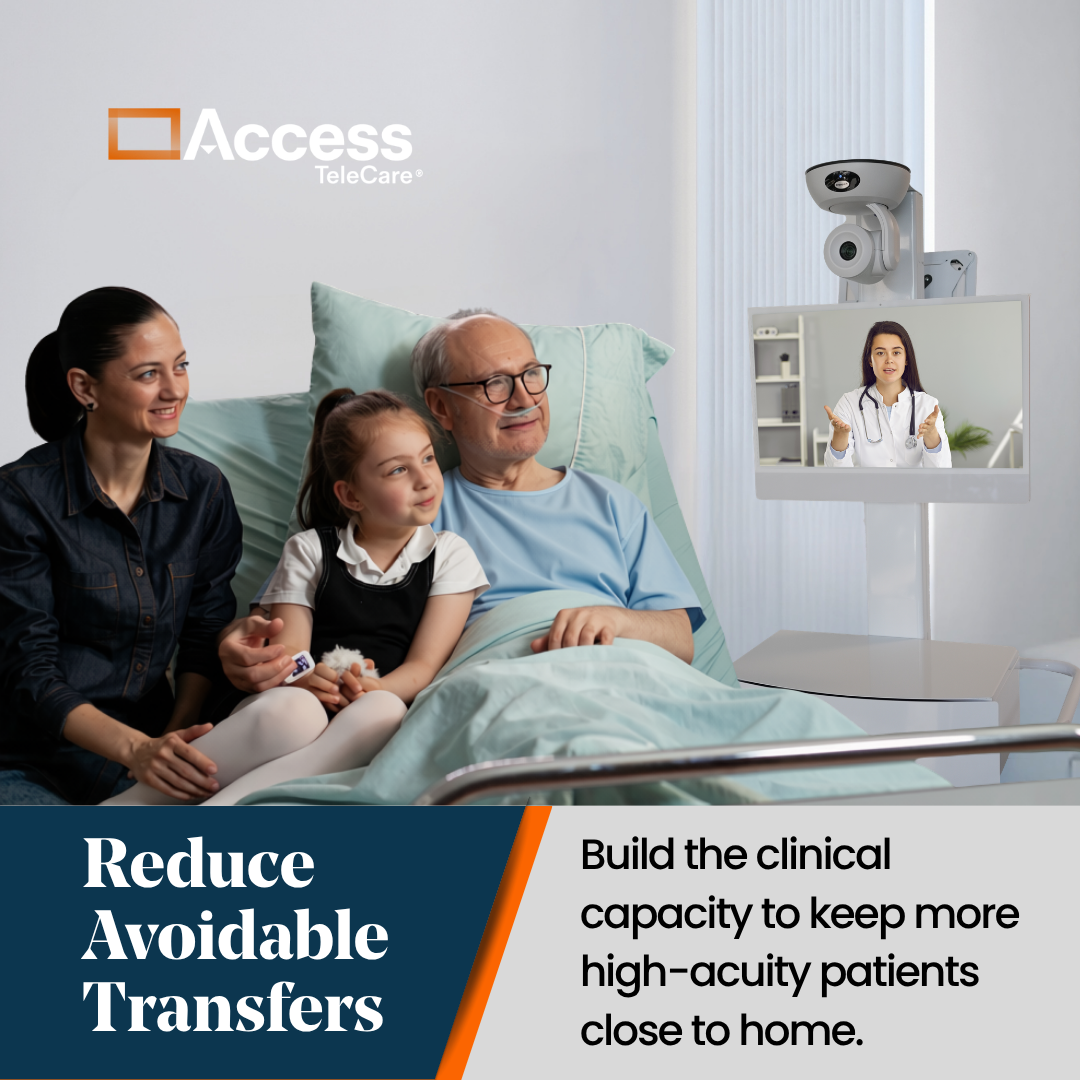
Reducing Avoidable Transfers Starts with Building the Right Clinical Capacity
Many hospital leaders know the moment: a critically ill patient [...]

A TeleICU Program Is Not a Video Consult: What It Takes to Build a High-Performing, Integrated Virtual Critical Care Program
By Pritam Ghosh, M.D., Chief Medical Officer, Medical Group President [...]

How Telemedicine Fits Into the Healthcare Affordability Equation
Acute Care Telemedicine, Behavioral Health, Emergency Care, General Telemedicine, Infectious Disease, maternal-fetal medicine, Rural Health Care, teleCardiology, teleEEG, teleEndocrinology, teleHospitalists, teleICU, teleInfectious Disease, teleMaternal-Fetal Medicine, teleNephrology, teleNeurology, telePsychiatry, telePulmonology, teleStroke
How Telemedicine Fits Into the Healthcare Affordability Equation
By Chris Gallagher, M.D. Founder and Chief Strategy Officer, Access [...]