World-Class Specialists in Maternal-Fetal Medicine
Partnering with hospitals is how Access TeleCare is improving access to world-class Maternal-Fetal Medicine specialists for communities of all sizes across the country. See how we do this and some of the results we’ve accomplished.
Maternal-Fetal Medicine
Access TeleCare maternal-fetal medicine program supports maternity providers to:
- Reduce unnecessary transfers.
- Increase number of local deliveries.
- Improve perinatal and maternal outcomes.
Our inpatient MFM programs have reduced transfers of pregnant women by 30 percent and increased the number of deliveries at the local hospital.
Our outpatient programs keep more than 90 percent of expectant families in their local communities for delivery.
We provide 24/7 inpatient coverage including antepartum rounding and ultrasound interpretation. No other private group or organization in the country offers this unparalleled level of MFM care.
Our MFM teams helps with transitions of care from inpatient to outpatient care settings. We also provide continuity of care through outpatient tele-MFM clinics, which ensures very few patients have to leave their local hospital system for ob/gyn-related care. When taking on interpretation of all ultrasound exams at a community obstetrics practice, our MFM team consistently demonstrated detection of abnormalities in 7-9 percent of scans deemed “normal”.
Explore teleMaternal-Fetal Medicine Case Studies

High-Risk Pregnancy Care That Kept Mother and Baby Close to Home
How Access TeleCare's teleMaternal-Fetal Medicine team helped a St. Luke's patient navigate an early delivery and receive expert care at the hospital she chose.
Keeping Complex Pregnancy Care Within the Local Health System
See how Access TeleCare’s teleMaternal-Fetal Medicine program supported a high-risk pregnancy complicated by pregestational diabetes

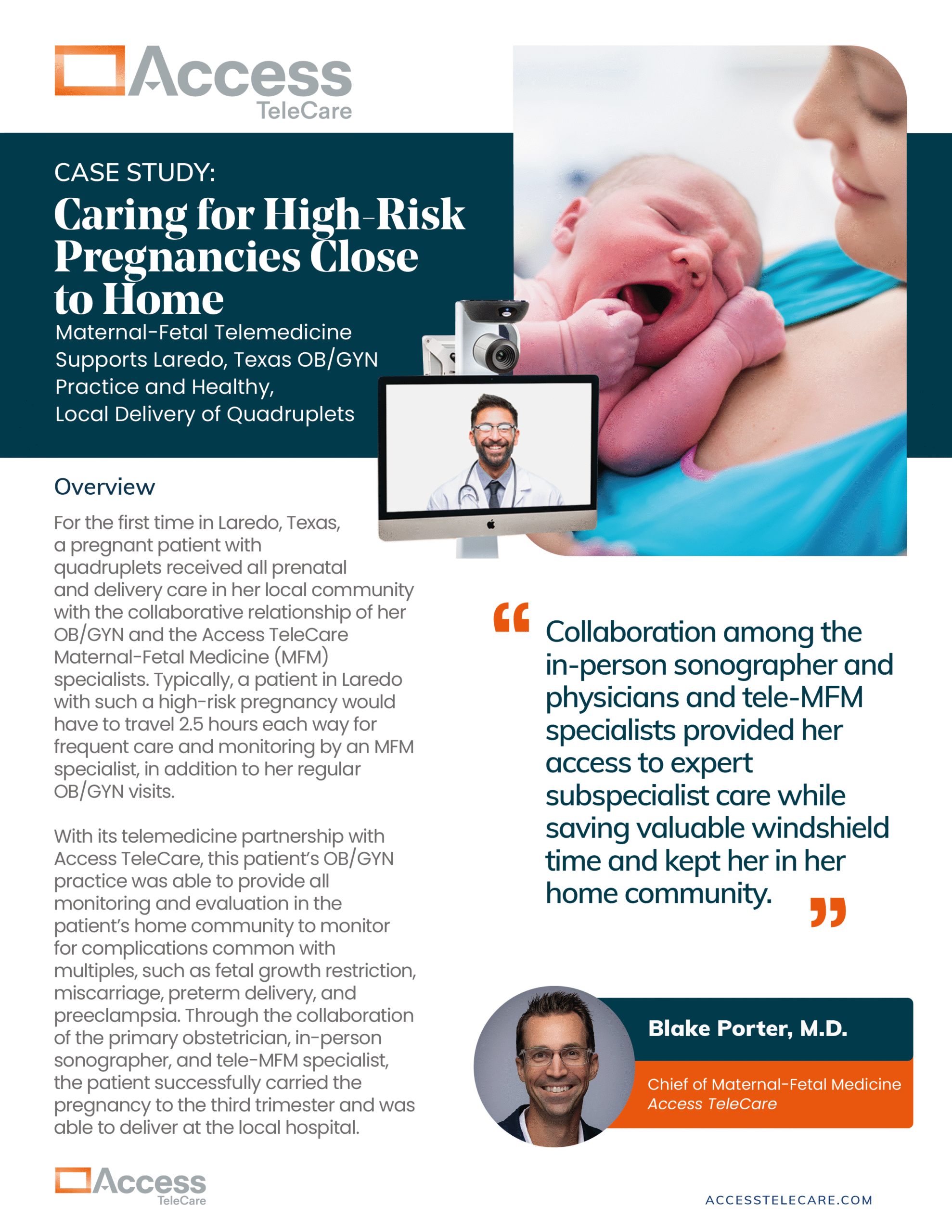
Caring for High-Risk Pregnancies Close to Home
Maternal-Fetal Telemedicine Supports Laredo, Texas OB/GYN Practice and Healthy, Local Delivery of Quadruplets Explore The Case Study Here >>
Rare Congenital Heart Defect Diagnosed by Access TeleCare’s Advanced Practice Sonography Team
A pregnant patient presented at a Colorado birth center for an anatomy scan. The local sonography team marked the scan as “normal/suboptimal” and requested a second interpretation by the Access […]
Frequently Asked Questions
Access TeleCare’s teleMaternal-Fetal Medicine service gives hospitals, OB programs, and outpatient clinics virtualaccess to maternal-fetal medicine specialists for high-risk pregnancy care. Access TeleCare’s specialists collaborate with local OB/GYNs, labor and delivery teams, sonographers, and hospitalclinicians to review patient history, interpret ultrasounds, guide care planning, and support complex pregnancymanagement. The service is designed to help hospitals strengthen local high-risk pregnancy care, reduceunnecessary transfers, support more local deliveries, and improve maternal and perinatal outcomes.
Access TeleCare supports high-risk pregnancy care by connecting local teams with maternal-fetal medicine specialists when patients need advanced pregnancy expertise.
Access TeleCare’s maternal-fetal medicine specialists can help assess maternal and fetal risk, review imaging, recommend monitoring plans, guide follow-up care, and support delivery planning. This gives onsite teams timely specialist input while helping expectant families remain connected to their local OB program whenever clinically appropriate.
TeleMaternal-Fetal Medicine can support care for patients with complex maternal conditions, fetal concerns, multiple gestation pregnancies, abnormal or unclear ultrasound findings, chronic disease during pregnancy, pregnancy complications, and patients who need closer monitoring due to elevated risk. The virtual specialist works with the onsite OB and labor and delivery team to determine the appropriate level of care, monitoring plan, delivery planning needs, and whether local management is clinically appropriate.
Access TeleCare helps hospitals keep more deliveries local by strengthening the specialty support available to OB programs.
With Access TeleCare’s maternal-fetal medicine specialists available virtually, hospitals can support more high-risk pregnancies, improve confidence in care planning, reduce avoidable referrals, and help patients stay connected to their local OB teams. Access TeleCare reports that its outpatient teleMaternal-Fetal Medicine programs keep more than 90% of expectant families in their local communities for delivery.
Yes. Access TeleCare’s teleMaternal-Fetal Medicine service supports both inpatient and outpatient maternal-fetal medicine care.
Access TeleCare’s inpatient support may include 24/7 coverage, antepartum rounding, ultrasound interpretation, and consultation for hospitalized pregnant patients. Outpatient support may include virtual maternal-fetal medicine clinics, follow-up visits, ultrasound review, care planning, and transition support after an inpatient stay.
This model helps hospitals support continuity across care settings instead of treating inpatient and outpatient high-risk pregnancy care as separate, disconnected services.
Virtual maternal-fetal medicine specialists improve continuity of care by helping patients stay connected to the same local OB program while receiving high-risk pregnancy expertise. Access TeleCare’s specialists support smoother transitions between inpatient and outpatient care, clearer communication with local providers, and fewer disruptions from unnecessary travel or fragmented referrals. For expectant families, that can mean more consistent monitoring, clearer care planning, and better support close to home.
Implementation timelines depend on the hospital’s existing OB program, ultrasound capabilities, clinical workflows, credentialing requirements, technology infrastructure, and desired scope of service. Access TeleCare works with hospitals and OB programs to align specialist coverage, ultrasound interpretation workflows, inpatient and outpatient processes, documentation, and team training so tele-Maternal-Fetal Medicine can be integrated into the local care model.
TeleMaternal-Fetal Medicine can support ultrasound and fetal monitoring programs by giving local teams access to specialist interpretation, second opinions, and care recommendations based on maternal and fetal findings. This is especially valuable when scans are complex, inconclusive, or require advanced review.
Yes. Access TeleCare’s teleMaternal-Fetal Medicine service can help hospitals expand women’s health services by adding maternal-fetal medicine expertise without requiring full-time onsite specialist recruitment.
This can strengthen local OB programs, support higher-risk patients, improve ultrasound and monitoring capabilities, reduce outmigration, and help hospitals keep more prenatal care and deliveries within the local system.
TeleMaternal-Fetal Medicine can improve patient satisfaction by reducing travel, keeping expectant families closer to their local providers, and improving access to specialty pregnancy care. It can also support outcomes by helping local teams identify risk earlier, interpret complex ultrasound findings, coordinate care more effectively, and make informed decisions about whether a patient can safely remain local or needs transfer. Access TeleCare’s maternal-fetal medicine program is positioned around reducing unnecessary transfers, increasing local deliveries, and improving perinatal and maternal outcomes.
Access TeleCare’s teleMaternal-Fetal Medicine service integrates with existing OB and labor and delivery teams as an extension of the local care team.
Virtual specialists collaborate with onsite physicians, nurses, sonographers, and hospital staff to review imaging, assess risk, guide treatment plans, support antepartum care, and help coordinate delivery planning. The goal is not to replace local OB care, but to strengthen it with timely maternal-fetal medicine expertise when pregnancies require a higher level of specialist input.
Specialty Care, Personal Connection
When a pregnancy requires specialized expertise, St. Luke’s patients can receive maternal-fetal medicine care without leaving their community.
Blake Porter, M.D., Chief Medical Officer of Specialty Services and Chief of Maternal-Fetal Medicine at Access TeleCare, explains how St. Luke’s physicians, nurses, and staff work alongside teleMaternal-Fetal Medicine specialists to support patients with high-risk pregnancies.
One patient shares how the team eased her concerns, reduced her stress, and made a virtual consultation feel personal throughout her pregnancy.
See the Difference for Patients
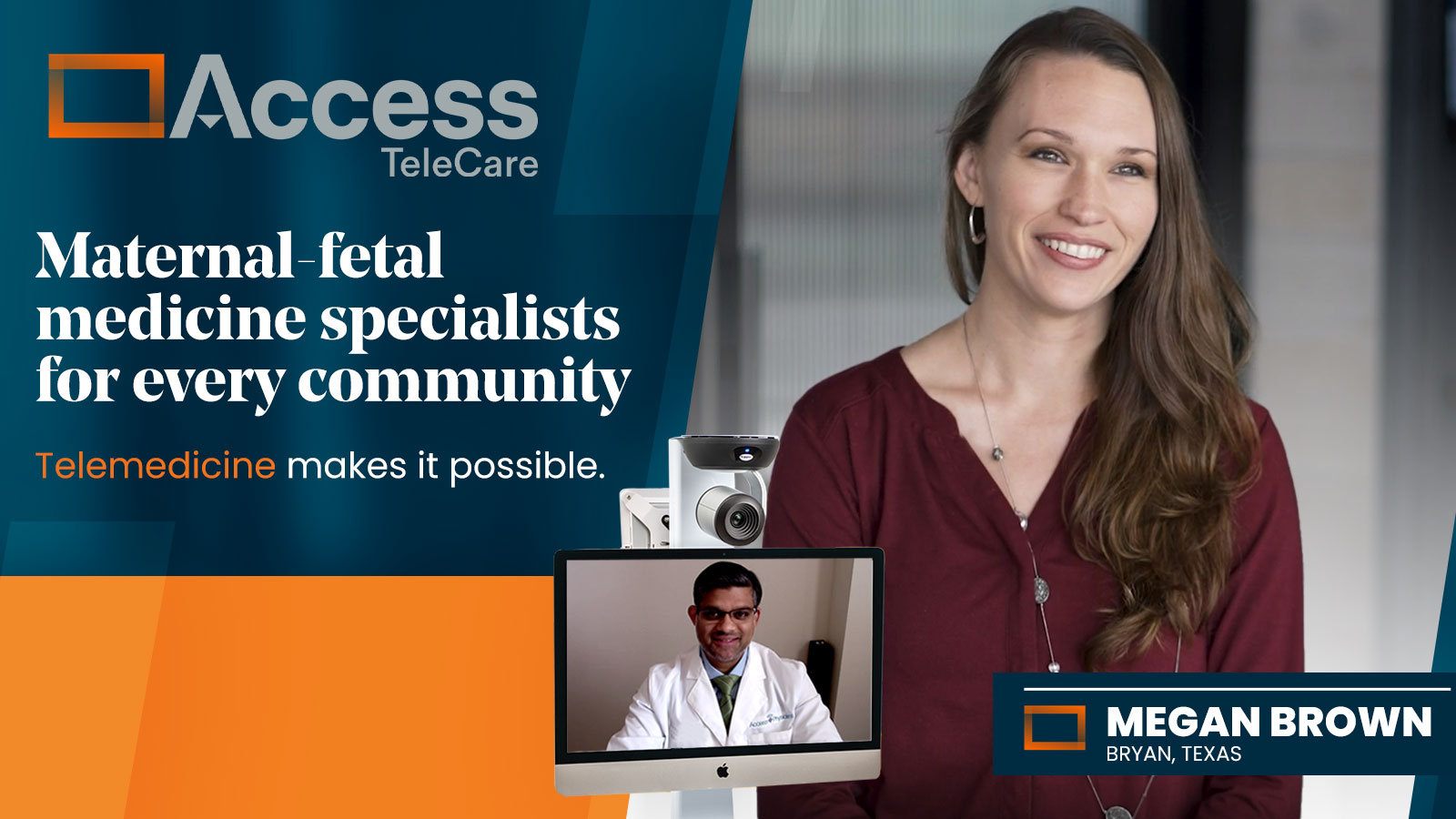
Like Megan Brown
Like Megan Brown
When Megan Brown and her husband arrived for a routine ultrasound at 20-weeks gestation, her OB/GYN noticed an abnormal mass on the baby’s lungs. Thanks to her OB/GYN’s telemedicine partnership, she and her husband were able to begin regular appointments with a maternal-fetal medicine specialist without the burden of traveling to an urban center. See how the convenience of teleMaternal-Fetal Medicine helped one family get the access they needed to crucial specialty services.

How Telemedicine Fits Into the Healthcare Affordability Equation
Acute Care Telemedicine, Behavioral Health, Emergency Care, General Telemedicine, Infectious Disease, maternal-fetal medicine, Rural Health Care, teleCardiology, teleEEG, teleEndocrinology, teleHospitalists, teleICU, teleInfectious Disease, teleMaternal-Fetal Medicine, teleNephrology, teleNeurology, telePsychiatry, telePulmonology, teleStroke
How Telemedicine Fits Into the Healthcare Affordability Equation
By Chris Gallagher, M.D. Founder and Chief Strategy Officer, Access [...]

Nurses at the Center of Telemedicine Care
Acute Care Telemedicine, Behavioral Health, Emergency Care, Events, General Telemedicine, Infectious Disease, maternal-fetal medicine, News, Rural Health Care, teleCardiology, teleEEG, teleEndocrinology, teleHospitalists, teleICU, teleInfectious Disease, teleMaternal-Fetal Medicine, teleNeurology, telePsychiatry, telePulmonology, teleStroke
Nurses at the Center of Telemedicine Care
Recognizing National Nurses Week | May 6–12 Every year from [...]
The Rural Health Transformation Opportunity: How Hospitals Can Put It into Practice
Acute Care Telemedicine, Behavioral Health, Emergency Care, General Telemedicine, In The Media, Infectious Disease, maternal-fetal medicine, teleCardiology, teleEEG, teleEndocrinology, teleHospitalists, teleICU, teleInfectious Disease, teleMaternal-Fetal Medicine, teleNephrology, teleNeurology, telePsychiatry, telePulmonology, teleStroke, Trending
The Rural Health Transformation Opportunity: How Hospitals Can Put It into Practice
Rural hospitals are entering a pivotal moment. With the launch [...]