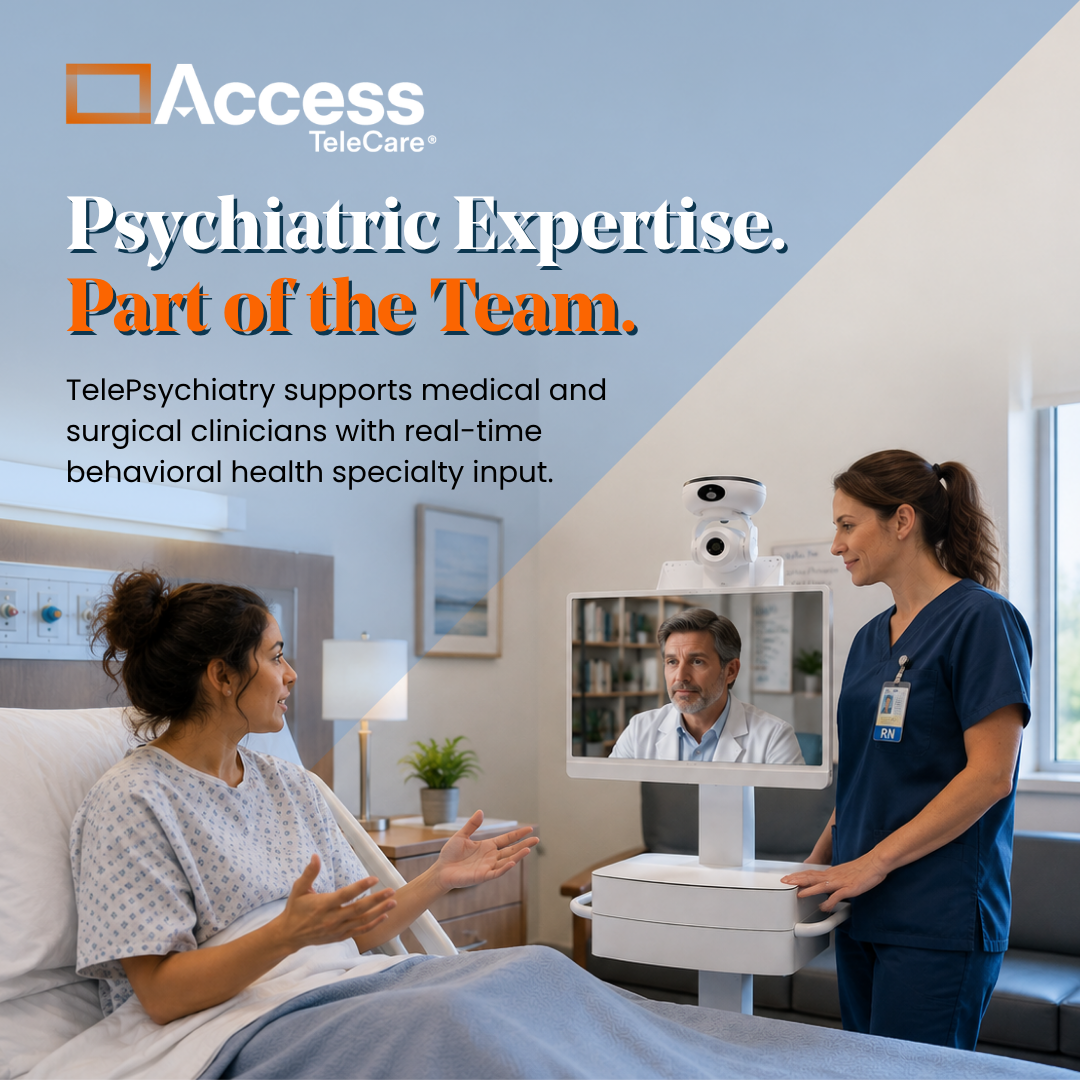
Behavioral health care is complex, requiring specialized expertise and a complete approach to address the needs of patients with mental health needs. At Access TeleCare, we’re using telemedicine to transform behavioral health outcomes, ensuring that patients receive the care they need, when and where they need it. From treating severe psychiatric conditions to improving patient satisfaction, telemedicine is making a measurable difference.
TelePsychiatry: Meeting the Needs of Complex Patients
Behavioral health patients often have complex needs that require specialized care.
Michael Genovese, M.D., J.D., chief medical officer, Behavioral Health at Access TeleCare, describes the critical role of telemedicine in treating psychiatric conditions, highlighting his team’s abilities in to treat a variety of needs from the most acute to others where emergent concerns are not as heightened.
“The patients that we see on our inpatient units, think about that as the ICU of Psychiatry. Those are patients with severe illness … patients with schizophrenia, bipolar disorder … a danger to themself or others because of suicidal or homicidal ideation,” Genovese said.
By providing access to expert providers, telemedicine ensures that even the most complex cases receive the attention they deserve.
Holistic Care for Co-Occurring Conditions
Behavioral health doesn’t exist in isolation. It’s deeply connected to physical health.
“Just because you have cardiac disease doesn’t mean that your depression or anxiety goes away, and the cardiologists are busy treating what they know about. They need our expertise to holistically take care of that patient in a proficient and really comprehensive way,” Genovese explained.
Telemedicine allows behavioral health providers to collaborate with medical teams, delivering holistic care that addresses both physical and mental health.
Improving Patient Outcomes and Satisfaction
Telemedicine is not only effective but is also improving patient satisfaction. Sandeep Bidari, president of behavioral health at Access TeleCare, highlights the importance of addressing patient experience, noting that when patients and providers at the bedside finally experience Access TeleCare’s telemedicine, expectations are exceeded.
“There’s a misperception at times that the patient experience will be worse. We work through those barriers and make sure that the patient experience exceeds expectations,” Bidari said.
By providing compassionate, expert care, telemedicine is breaking down barriers and exceeding expectations.
Life-Saving Interventions
Telemedicine is also enabling life-saving interventions that wouldn’t be possible otherwise. Genovese shares a powerful example, highlighting the flexibility and diverse solutions of the team.
“One of our [Psychiatric] providers who was in the emergency room performed what the family and the staff described as a stroke evaluation. The patient was in fact having a stroke that accounted for the symptoms that he was manifesting. Our telePsychiatrist was able to save that patient’s life,” he said.
When you enable world-class providers to operate through telemedicine, you’re bringing expert care to patients that they would otherwise not receive. In the case mentioned above by Dr. Genovese, without the outside-the-box thinking of the psychiatrist to find the root cause of the issue (which was a stroke) the health outcome of the patient could’ve been tremendously worse – leading to significant brain damage or death. To read more about this intervention, read our patient case study here. Telemedicine is truly transforming behavioral health care by addressing complex needs, improving patient satisfaction, and enabling life-saving interventions. At Access TeleCare, we’re proud to be leading this transformation, ensuring that every patient receives the care they need to thrive.
Interested in learning more about how telemedicine can transform behavioral health outcomes in your organization? Contact us today to see how Access TeleCare can help.