Infectious disease care is often the difference between a patient stabilizing quickly or spiraling into complications. But for many hospitals, especially smaller community and rural facilities, consistent access to infectious disease expertise isn’t guaranteed. TeleInfectious Disease is changing that — effectively, measurably, and at scale.
Across hospitals nationwide, Access TeleCare’s teleInfectious Disease programs are helping clinicians make faster, more accurate diagnoses, reduce lengths of stay, optimize antibiotic use, avoid transfers, and keep patients with complex conditions close to home for their care.
The following real-world examples show what that impact looks like in practice.
Treating More Complex Patients with a teleInfectious Disease Program— Without Transfers
A 300-bed hospital facing high hospitalist turnover and limited ID coverage launched a teleInfectious disease program to support increasingly complex patient cases.
With ID specialists involved early in admissions, the hospital saw meaningful improvements within the first year, including a 25 percent increase in all-payer revenue. Clinical and operational gains included:
- Shorter length of stay
- Reduced outbound transfers
- Increased inbound transfers from other hospitals
- Fewer days on antibiotics
- Care teams are able to treat higher-acuity patients locally, without overwhelming on-site staff.
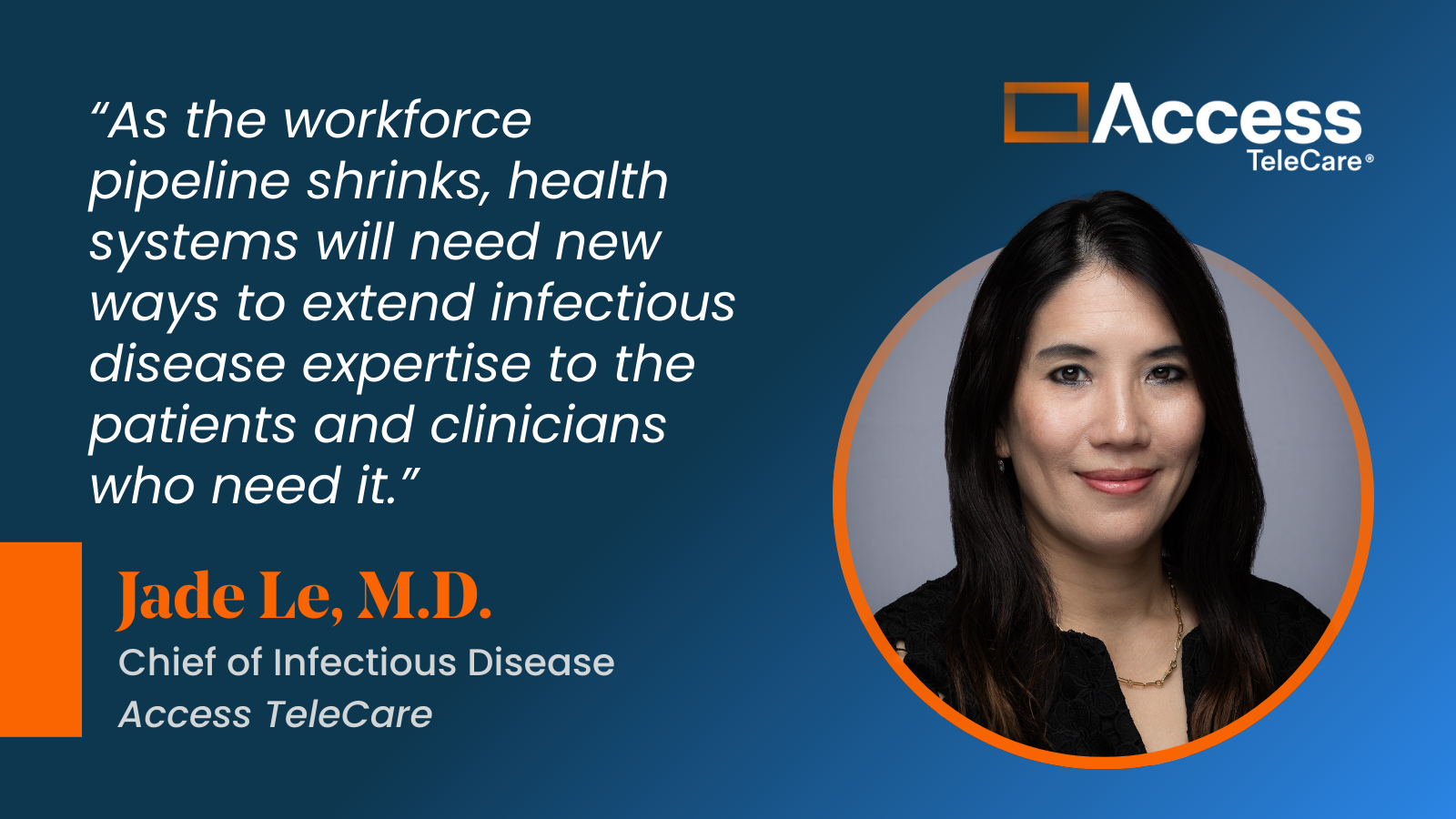
“Our specialists don’t work in silos,” said Dr. Le. “We integrate early, guide decisions in real time, and help hospitals confidently manage complexity instead of transferring it away.”
Read the full case study – Boosting Care Access with Integrated TeleInfectious Disease Experts
Turning Infectious Disease Specialty Access into Sustainable Performance
In Alabama, a hospital partnered with Access TeleCare to address rising demand for infectious disease care and reduce the number of outbound patient transfers. Through real-time consultations, standardized protocols, and close collaboration with on-site clinicians, the hospital expanded its ability to care for complex infectious disease cases locally.
The program not only improved patient outcomes, it strengthened the hospital’s operational performance by retaining cases that would otherwise be transferred, contributing to a 50 percent increase in high-complexity patient care volume and 74 percent increase in net infectious disease revenue.
“TeleInfectious disease programs allow hospitals to deliver higher-level care while using staffing and resources more effectively,” Dr. Le said. “That’s how access turns into sustainability.”
Saving a Life by Getting the Diagnosis Right
A patient experiencing frequent sinus infections, lung issues, and chest pains appeared to have tuberculosis, but the insight and experience of Access TeleCare infectious disease specialist revealed something else entirely: a rare autoimmune disease.
Initially, placed on the four-drug regimen recommended for TB, the patient’s condition worsened, and our infectious disease specialist was consulted. Virtually.
After reviewing the case, our infectious disease specialist suspected granulomatosis with polyangiitis, and targeted testing confirmed the new diagnosis, allowing care teams to pivot treatment immediately.
The result wasn’t just better care. It was harm avoided. The patient was spared months of unnecessary drug therapies and received the right treatment to be able to recover.
“Telemedicine put the investigative expertise of a highly trained infectious disease specialist exactly where it was needed,” said Access TeleCare Chief of Infectious Disease Jade Le, M.D.
See the full case study – The Right Diagnosis with Telemedicine
Local Care with Community-Wide Impact
In a West Texas hospital, an elderly patient returned to the emergency department after a hospital stay for atrial fibrillation and experiencing new symptoms — fever, fatigue, and declining mental status. Initial testing didn’t reveal a clear cause.
After consultation with an Access TeleCare infectious disease specialist virtually, the patient was thought to have contracted a rare mosquito-borne illness. With additional testing, West Nile virus was confirmed.
Beyond guiding the patient’s treatment and recovery, the diagnosis triggered notifications to state and county health officials, prompting increased community surveillance and public health awareness for the rare, but serious diagnosis.
“A rare diagnosis like this may have gone unnoticed without timely infectious disease expertise,” Dr. Le noted. “Telemedicine made that timely expertise available.”
The Common Thread: Expertise, Integrated
Across each of these real-world examples, the impact isn’t due to technology alone. It’s about timely, integrated access to experts that fits into hospital workflows, supporting clinicians, strengthening care, and improving outcomes for patients who otherwise might not receive specialty care in time.