
Patient impact Stories
A Rare Fungal Infection Recognized Before It Reached the Brain
How Access TeleCare’s teleInfectious Disease coverage helped initiate treatment within hours and transfer a patient for definitive care in less than 24 hours
The Case
A 50-year-old truck driver with poorly controlled diabetes developed severe swelling and protrusion of one eye. He had already received antibiotics without improvement and was nearly discharged from a local emergency facility before he and his wife pushed for further evaluation. A local ophthalmologist examined him and called Jade Le, M.D., Access TeleCare’s Chief of Infectious Disease, who was the on-call virtual infectious disease physician at the time.
Although the initial concern was a routine infection around the eye, Dr. Le recognized that the patient’s diabetes and rapidly worsening symptoms could indicate Rhinocerebral mucormycosis, an invasive mold infection entering through the sinuses and spreading toward the eye with an approximate 50% mortality rate. She directed the ophthalmologist to send him to the emergency department and recommended immediate antibacterial and antifungal treatment.
The Care Plan
After the patient was admitted to the hospital overnight, Dr. Le was engaged for a patient consultation. She identified two gaps in the diagnosis process: the patient needed an MRI and evaluation by an ear, nose, and throat specialist. She coordinated with the local hospital team to move both forward.
The MRI showed the infection had spread through the sinus bones and around the eye but had not reached the brain. An endoscopic examination also revealed tissue concerning for invasive mold. Dr. Le and the on-site hospitalist immediately began arranging transfer to a tertiary care center, where the patient could receive extensive surgical debridement and other specialty care.
The Result
Less than 24 hours after the ophthalmologist’s initial call to the teleInfectious Disease specialist, the patient was admitted to the tertiary care center after receiving appropriate treatment at the local hospital.
At the patient’s three-month follow-up, he had avoided removal of the affected eye, had undergone needed nasal debridement, was continuing care with a local infectious disease physician, and had started managing his diabetes more appropriately.
“If the ophthalmologist had not called me, this dangerous invasive fungal infection could have been missed with potentially life-threatening consequences. Instead, within less than 24 hours, the patient was transferred to a tertiary care center where treatment was initiated within hours. Three months later, the patient was doing well and was able to preserve his eye.” Jade Le, M.D.
Dr. Jade Le
Chief of Infectious Disease, Access TeleCare
Download the Patient Impact Story
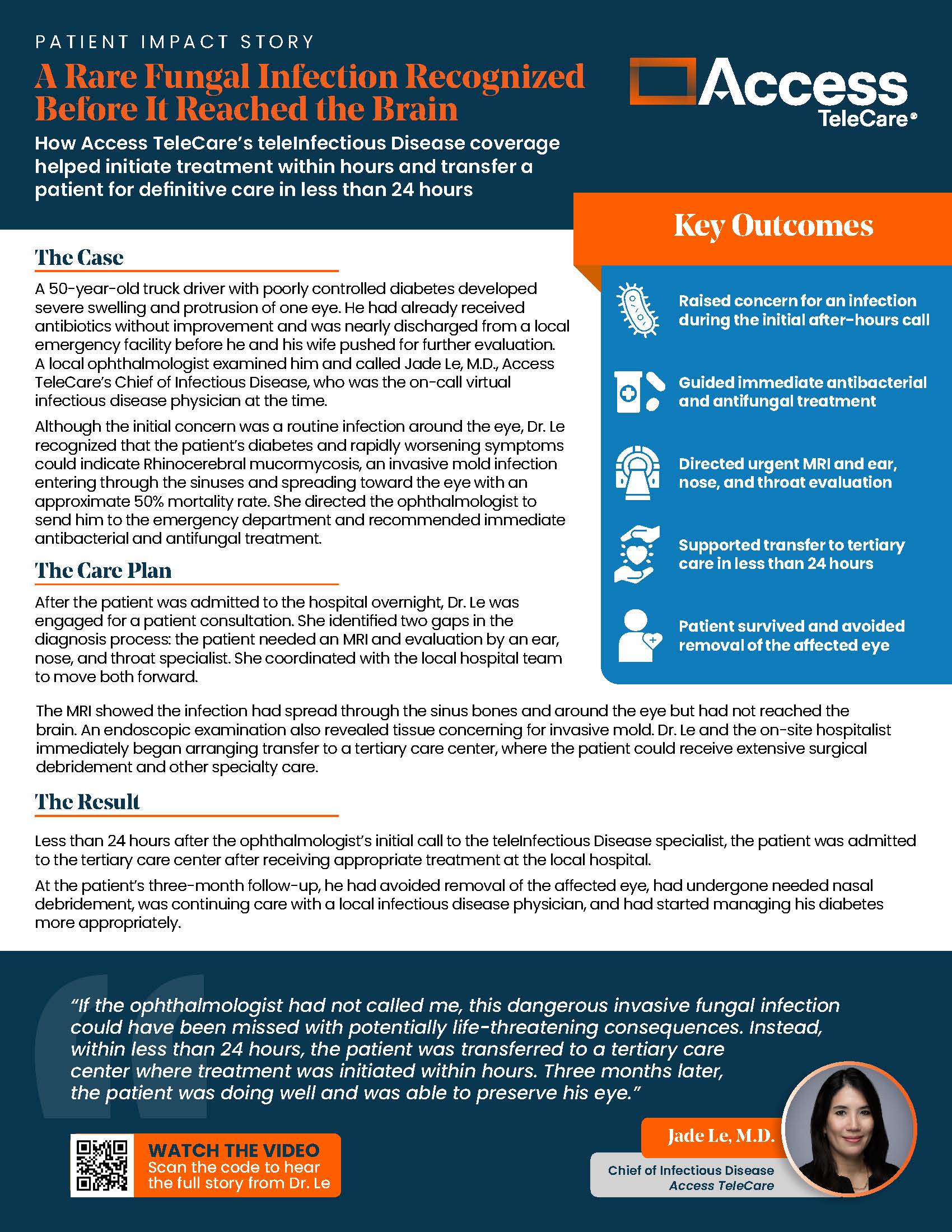
In this patient impact story, an after-hours teleInfectious Disease consultation helped a Texas hospital recognize a suspected invasive fungal infection in a patient with poorly controlled diabetes and severe eye swelling. Jade Le, M.D., guided immediate antifungal treatment; urgent imaging; ear, nose, and throat evaluation; and transfer to a tertiary care center in less than 24 hours. The patient survived and avoided removal of the affected eye.
Read the latest from Access TeleCare

How Telemedicine Fits Into the Healthcare Affordability Equation
Acute Care Telemedicine, Behavioral Health, Emergency Care, General Telemedicine, Infectious Disease, maternal-fetal medicine, Rural Health Care, teleCardiology, teleEEG, teleEndocrinology, teleHospitalists, teleICU, teleInfectious Disease, teleMaternal-Fetal Medicine, teleNephrology, teleNeurology, telePsychiatry, telePulmonology, teleStroke
How Telemedicine Fits Into the Healthcare Affordability Equation
By Chris Gallagher, M.D. Founder and Chief Strategy Officer, Access [...]

Hospital Week: Recognizing the Institutions That Hold Communities Together
Acute Care Telemedicine, Behavioral Health, Emergency Care, Events, General Telemedicine, News, Rural Health Care, teleCardiology, teleEEG, teleEndocrinology, teleHospitalists, teleICU, teleInfectious Disease, teleMaternal-Fetal Medicine, teleNeurology, telePsychiatry, telePulmonology, teleStroke
Hospital Week: Recognizing the Institutions That Hold Communities Together
In many places, especially outside major metropolitan areas, hospitals are [...]

Nurses at the Center of Telemedicine Care
Acute Care Telemedicine, Behavioral Health, Emergency Care, Events, General Telemedicine, Infectious Disease, maternal-fetal medicine, News, Rural Health Care, teleCardiology, teleEEG, teleEndocrinology, teleHospitalists, teleICU, teleInfectious Disease, teleMaternal-Fetal Medicine, teleNeurology, telePsychiatry, telePulmonology, teleStroke
Nurses at the Center of Telemedicine Care
Recognizing National Nurses Week | May 6–12 Every year from [...]