Improving Stroke Response Speed: Strengthening Stroke Response with a Collaborative TeleStroke Model
Access TeleCare Case Study
Stroke response improves when decisions move forward without waiting for clarification. By embedding teleStroke directly into existing workflows, this partnership with Access TeleCare transformed how teams operated under pressure and made speed a byproduct of alignment.
Hospital Telemedicine Solutions
The Challenge:
A 352-bed acute care hospital in California wanted to improve its Door-to-Needle (DTN) metrics for acute ischemic stroke patients.
Stroke response requires tight coordination across multiple teams, technologies, and time-sensitive decision points, where even small delays can significantly impact outcomes.
The focus was not on building a stroke program from scratch, but on refining an already established approach, reducing variability, improving reliability, and ensuring every stroke activation moved as efficiently as possible from arrival to treatment.
The Solution:
The hospital partnered with Access TeleCare to strengthen its teleStroke program through close collaboration of on-site and virtual clinicians and deeper integration with hospital workflows.
Rather than functioning as a standalone service, Access TeleCare worked in lockstep with clinical, operational, and leadership teams to ensure the hospital was fully realizing the value of its teleStroke coverage. The partnership emphasized:
- Integrated coordination between Access TeleCare clinicians and on-site teams
- Alignment across stroke activation and treatment workflows
- Clear communication and shared accountability during stroke events
- Ongoing identification and resolution of operational barriers
This collaborative approach allowed both on-site and virtual teams to move quickly, adjust in real time, and stay focused on accelerating treatment without adding unnecessary burden to frontline staff.
“This level of Door-to-Needle improvement doesn’t happen without alignment. The collaboration between our teams and Access TeleCare fundamentally changed how we deliver stroke care. They [Access TeleCare] came in quickly, reliably, with shared accountability, and right where our sticking point was.”
– System Stroke Program Supervisor

TeleNeurology solutions include:
TeleNeurology Results
Average 43% increase in number of patients treated for acute ischemic stroke improved from 95.9 minutes to 43 minutes
43% increase in number of patients treated for acute ischemic stroke
Comparing 2024 to 2025, the hospital was better equipped to treat stroke patients efficiently, leading to a 43 percent increase in the number of patients treated per month for acute ischemic stroke.52.9-minute reduction in Door-to-Needle time
52.9-minute reduction in Door-to-Needle time
This improvement represented a fundamental shift in stroke care delivery. What had previously been a prolonged process became faster, more reliable, and aligned across teams
Average DTN improved from 95.9 minutes to 43 minutes
Average DTN improved from 95.9 minutes to 43 minutes
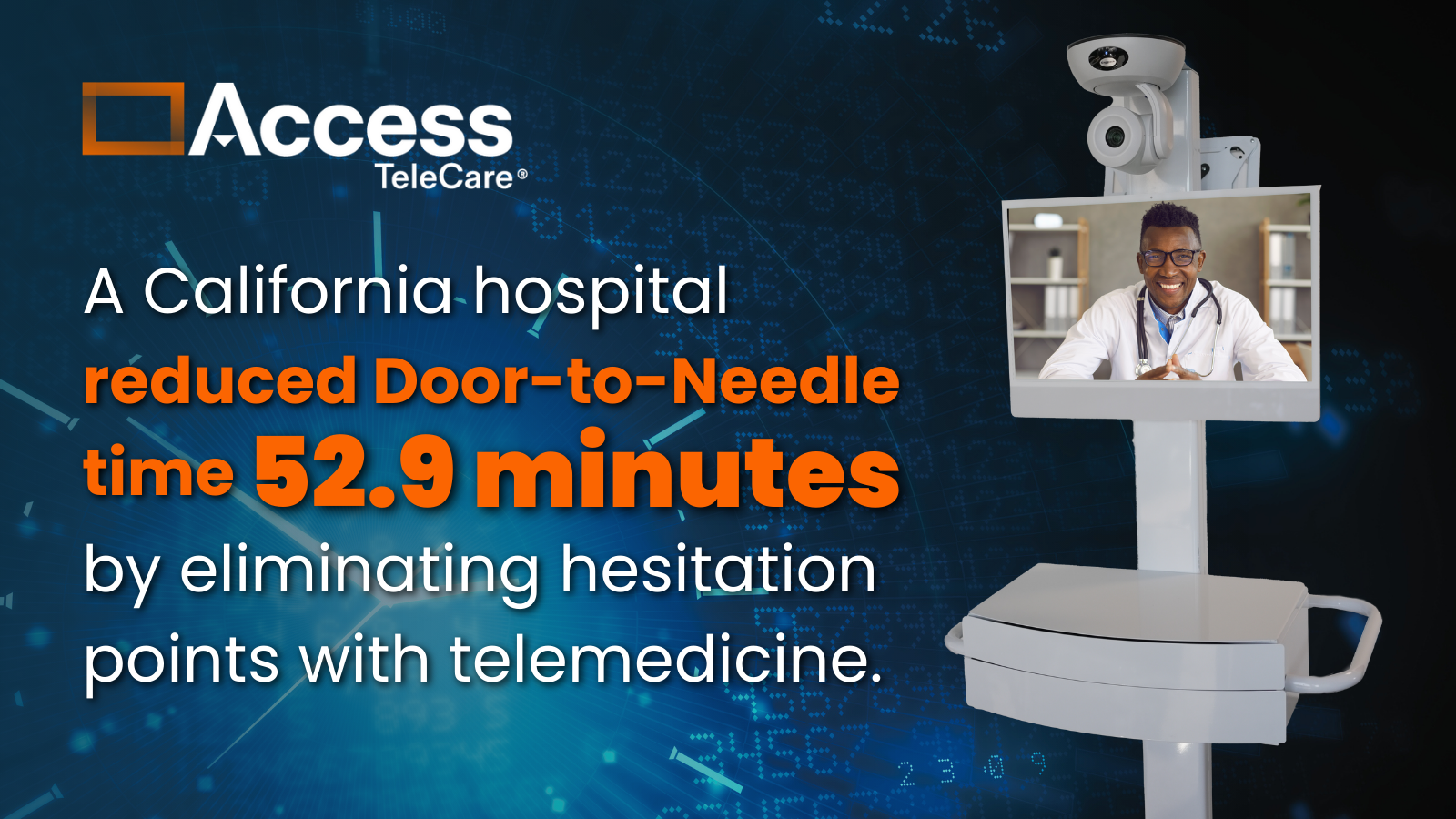
Within just three months of the teleStroke model, the hospital achieved a 52.9-minute reduction in Door-to-Needle time, cutting average DTN from 95.9 minutes to 43 minutes for thrombolytic stroke cases.
TeleNeurology Outcomes
Within just three months of the teleStroke model, the hospital achieved a 52.9-minute reduction in Door-to-Needle time, cutting average DTN from 95.9 minutes to 43 minutes for thrombolytic stroke cases.
This improvement represented a fundamental shift in stroke care delivery. What had previously been a prolonged process became faster, more reliable, and aligned across teams, creating a foundation for sustained performance improvement. Comparing 2024 to 2025, the hospital was better equipped to treat stroke patients efficiently, leading to a 43 percent increase in the number of patients treated per month for acute ischemic stroke.
More on Access TeleCare’s Telemedicine Programs

The Rural Health Transformation Opportunity: How Hospitals Can Put It into Practice
Acute Care Telemedicine, Behavioral Health, Emergency Care, General Telemedicine, In The Media, Infectious Disease, maternal-fetal medicine, teleCardiology, teleEEG, teleEndocrinology, teleHospitalists, teleICU, teleInfectious Disease, teleMaternal-Fetal Medicine, teleNephrology, teleNeurology, telePsychiatry, telePulmonology, teleStroke, Trending