
The Case
When a patient with an unusual blood clotting disorder presented at a New Mexico hospital with fever and a staph infection in his bloodstream following a recent stent placement, the Access TeleCare teleInfectious Disease team began a thorough evaluation to determine the source of infection. Because the patient was on blood thinners and had undergone the stent placement about a month earlier, the Access TeleCare teleInfectious Disease team conducted a thorough examination to locate with certainty the source of the infection.
The examination helped rule out infection in the heart valves and identified an infection in the spine. Access TeleCare’s teleInfectious Disease specialist recommended a six-week course of intravenous antibiotics and additional testing to determine whether the recently placed stent was infected.
The Care Plan
After completing the initial antibiotic course in July, the patient returned to the same hospital three months later with fever and the same staph infection in his blood. The Access TeleCare team recommended further testing and helped arrange transfer to another New Mexico hospital where the specialized test was available.
Testing confirmed the infection was in the stent. Because Access TeleCare also covered teleInfectious Disease services at the receiving hospital, the team continued supporting the patient’s care, developed a treatment plan, and coordinated his return to the original hospital. He was ultimately discharged with a PICC line for six weeks of intravenous antibiotics.
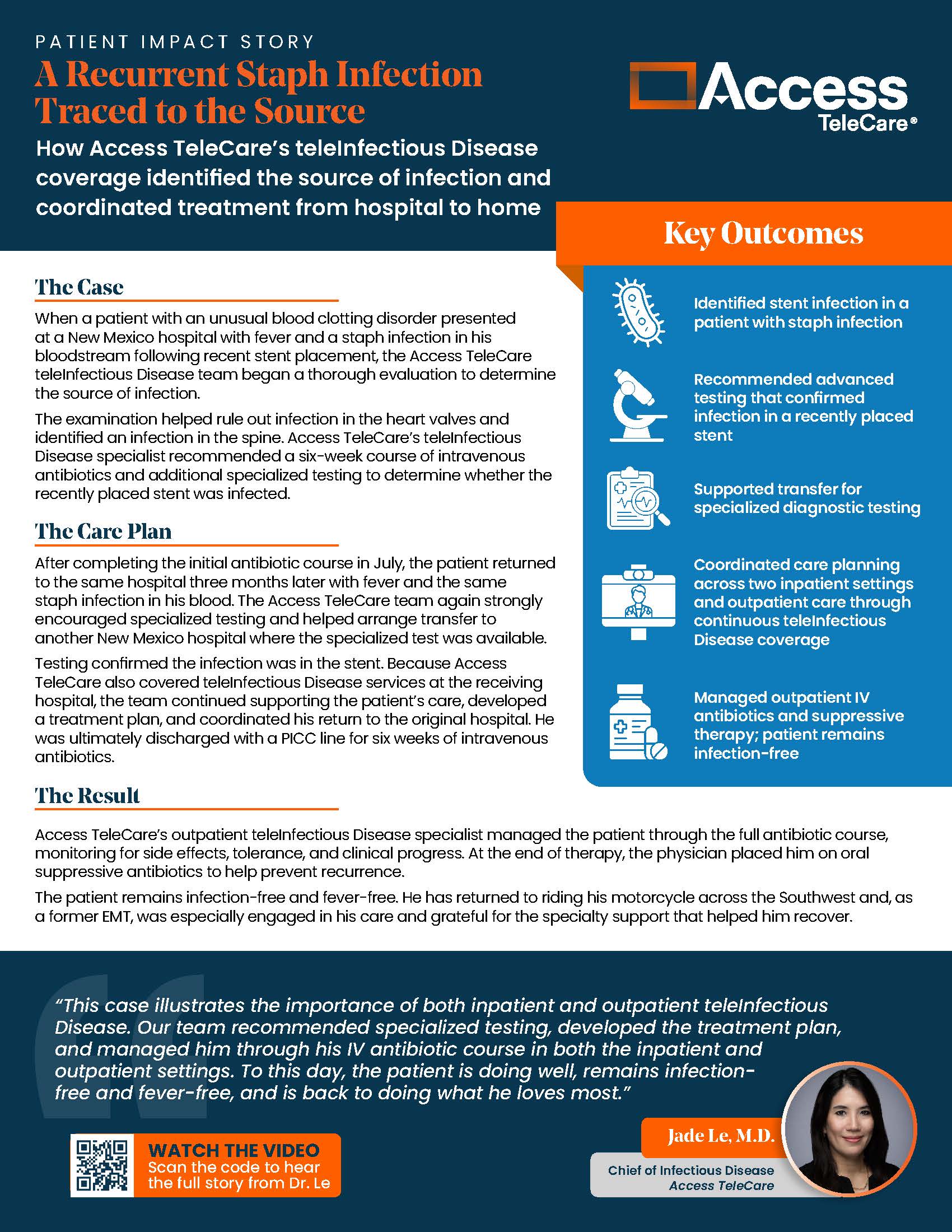
Access TeleCare’s teleInfectious Disease team helped identify the source of a recurrent staph bacteremia afflicting a New Mexico patient. Collaborating with the on-site team, clinicians treated the patient’s spinal infection and identified an infected stent as the source of the staph infection.
The team supported diagnostic escalation, transfer for specialized testing, coordinated care across two hospitals, and outpatient IV antibiotic management. The patient remains infection-free and has returned to doing what he loves.
Results
Access TeleCare’s outpatient teleinfectious disease specialist managed the patient through the full antibiotic course, monitoring for side effects, tolerance, and clinical progress. At the end of therapy, the physician placed him on oral suppressive antibiotics to help prevent recurrence.
The patient remains infection-free and fever-free. He has returned to riding his motorcycle across the Southwest and, as a former EMT, was especially engaged in his care and grateful for the specialty support that helped him recover.
Read the Latest from Access TeleCare

Beyond the Screen: How Physician Assistants Extend the Reach of Specialty Care
By Lauren Ingram, MSN, MS, APRN, FNP-C, Chief of Advanced [...]
Access TeleCare Joins Cross-State Care Coalition as a Founding Member
By Giulia Block, Esq., Chief Legal Officer and Head of [...]

On-Demand Webinar: Rural Strategy Rewritten: Access, Footprint, and the Future of Community Care
Rural healthcare leaders are being asked to preserve [...]

The Rise of the Chief Advanced Practice Clinician Role
By Lauren Ingram, MSN, MS, APRN, FNP-C, Chief of Advanced [...]