
The Case
A 205-bed hospital in Idaho depended on one local infectious disease physician to cover both inpatient and outpatient care needs. In addition to caring for patients in the clinic and hospital, the physician was regularly on call during weekdays and weekends and fielded questions from clinicians throughout the local area. The demands left little time for professional development or time away, creating a serious risk of burnout. Hospital leaders valued the physician and needed a sustainable way to protect this essential local resource without reducing access to specialty care.
The Solution
The hospital partnered with Access TeleCare to implement teleInfectious Disease inpatient consult coverage Monday through Friday from 7 a.m. to 5 p.m.
Access TeleCare infectious disease specialists evaluate new patients, monitor hospitalized patients daily, review laboratory results, prescribe and manage antibiotic and other therapies, and adjust treatment and discharge recommendations as new clinical information becomes available. The telemedicine team communicates directly with on-site hospitalists, surgeons, critical care clinicians, and other local teams through secure messaging, creating the responsiveness of an embedded specialist service.
When a patient needs continued infectious disease care after discharge, a defined handoff workflow transfers care to the local infectious disease specialist. The process gives the outpatient specialist the diagnosis, treatment history, and follow-up plan needed to continue care without gaps or duplication.
“The teleInfectious Disease program gives the hospital reliable inpatient infectious disease coverage while supporting its local specialist in focusing on outpatient care. Patients are seen quickly, care teams receive timely recommendations, and the hospital has reduced average length of stay by two days.”
Jade Le, M.D.
Chief of Infectious Disease
Access TeleCare
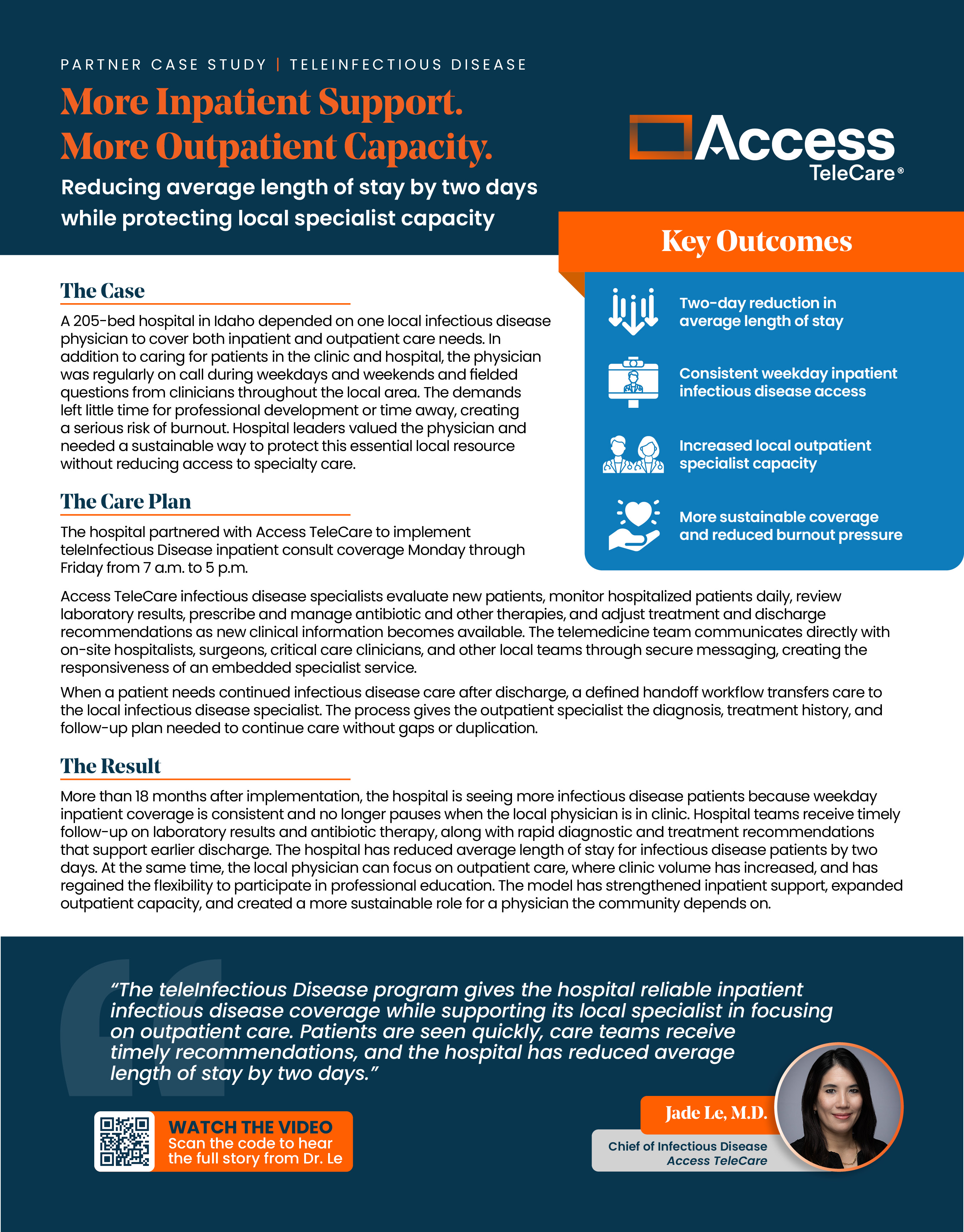
For one Idaho hospital, Access TeleCare helped connect those parts of the care journey. TeleInfectious Disease clinicians manage weekday inpatient consults and follow-up, while a structured handoff keeps the local specialist informed and ready to continue care in the outpatient setting.
The shift helped reduce average length of stay by two days.
Results
Two-day reduction in average length of stay
Following implementation of teleInfectious Disease consultations and structured antimicrobial stewardship oversight, the hospital reduced length-of-stay two days.
Consistent weekday inpatient infectious disease access
Inpatient teams gained dependable specialist support, while the organization protected the long-term value of its local physician resource.
More sustainable coverage and reduced burnout pressure
The local physician is now able to focus on outpatient care, where clinic volume has increased, and has regained the flexibility to participate in professional education.
Read the Latest from Access TeleCare
Beyond the Screen: How Physician Assistants Extend the Reach of Specialty Care
By Lauren Ingram, MSN, MS, APRN, FNP-C, Chief of Advanced [...]
Access TeleCare Joins Cross-State Care Coalition as a Founding Member
By Giulia Block, Esq., Chief Legal Officer and Head of [...]

On-Demand Webinar: Rural Strategy Rewritten: Access, Footprint, and the Future of Community Care
Rural healthcare leaders are being asked to preserve [...]

The Rise of the Chief Advanced Practice Clinician Role
By Lauren Ingram, MSN, MS, APRN, FNP-C, Chief of Advanced [...]