Reduced Length of Stay
Earlier intervention and specialist-guided treatment decisions help prevent delays and complications.
Timely Inpatient Care
Rapid access to infectious disease expertise for acute consults, complex infections, and escalation decisions.
Board-Certified Expertise
Consistent access to experienced infectious disease physicians-without recruitment challenges.
Fewer
Transfers
Transfers
Support local care by managing complex cases in place whenever clinically appropriate.
Operational and Financial
Benefits
Benefits
Improved throughput, reduced unnecessary antibiotic use, and stronger compliance with quality standards.

“Infectious disease care is about timing, precision, and stewardship. Telemedicine allows us to bring that expertise to hospitals that otherwise wouldn’t have access, without delay.”
Binh Minh “Jade” Le, M.D.
Chief of Infectious Disease
Access TeleCare
Comprehensive Infectious Disease Support – built for hospitals
Access TeleCare’s TeleInfectious Disease program supports hospitals with inpatient consults, antimicrobial stewardship, and continuity of care beyond discharge. Our physicians integrate directly with local teams, workflows, and EMRs to deliver reliable specialty care without disruption.

Telemedicine Antibiotic Stewardship Program
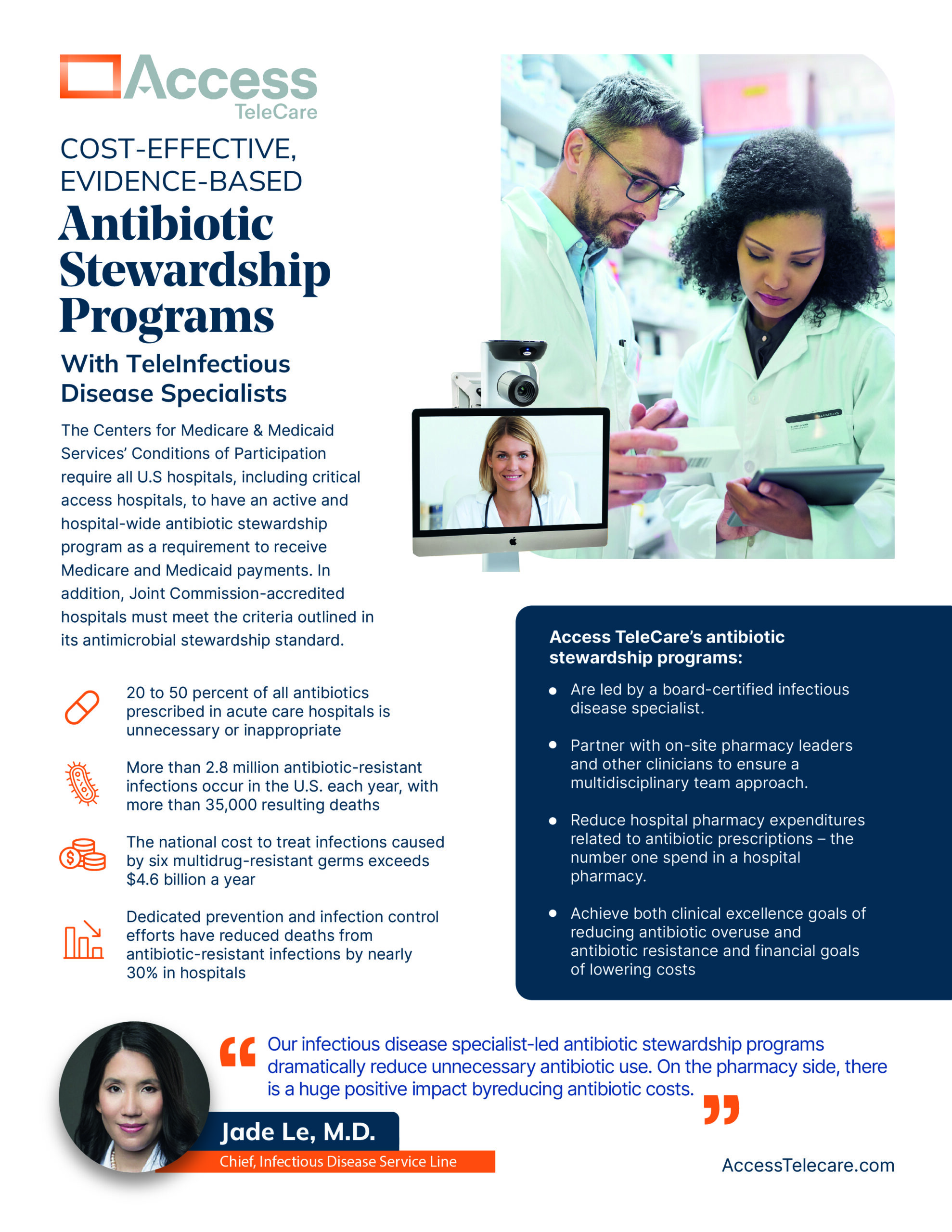
Our telemedicine-based Antimicrobial Stewardship Program extends infectious disease expertise across your facility – supporting appropriate antibiotic use, resistance reduction, and regulatory expectations. These programs:
- Reduce hospital pharmacy expenditures related to antibiotic prescriptions – the number one spend in hospital pharmacy.
- Achieve clinical excellence goals of reducing both antibiotic overuse and antibiotic resistance and financial goals of reducing costs.
- Reduce antimicrobial therapy days
- Partner with other virtual specialists and on-site teams.

Antimicrobial Stewardship, Led by Infectious Disease Experts
Our telemedicine antibiotic stewardship program can be implemented in all hospitals, even those without in-house or on-site infectious disease specialists.
Antibiotic Stewardship
Our telemedicine antibiotic stewardship program can be implemented in all hospitals, even those without in-house or on-site infectious disease specialists.
Outpatient Infectious Disease Clinic
TeleInfectious Disease extends beyond the hospital to support outpatient consults and follow-up care for patients requiring ongoing infectious disease management.
Explore Case Studies

Partnering to Deliver Consistent Specialty Care
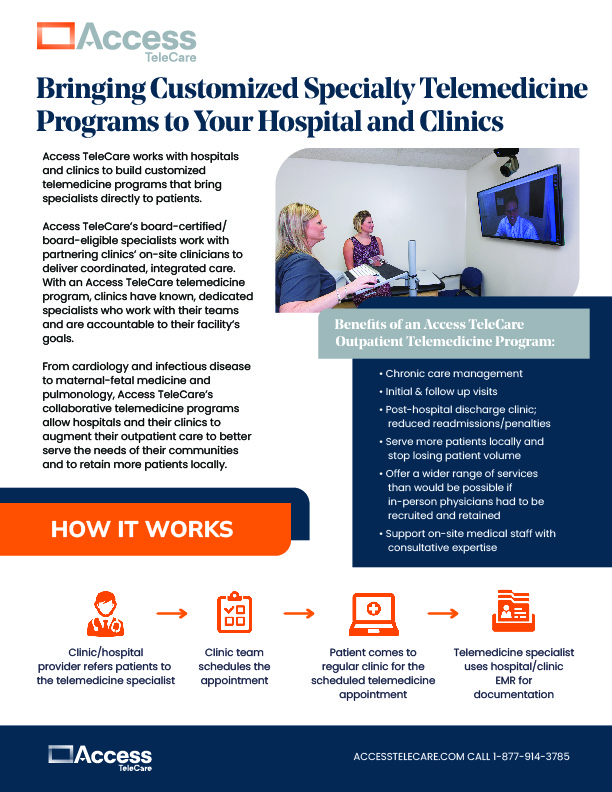
How one large regional health system uses telemedicine across massive region to address workforce needs and timely care Explore The Case Study Here >>

The Right Diagnosis with Telemedicine
On-Site and Infectious Disease Telemedicine Specialists Collaborate for Accurate Diagnosis and Life-Saving Care. Explore The Case Study Here >>
Expanding Access to Infectious Disease Care: teleInfectious Disease Program Success
To address the growing demand for specialized care and reduce patient transfers, a hospital in Alabama partnered with Access TeleCare to implement a teleInfectious Disease program.

Complex Care Coordination with Telemedicine
A morbidly obese patient with multiple conditions received coordinated care in real-time from Access TeleCare pulmonologist and infectious disease specialists. Explore The Case Study Here >>

Dr. Jade Le provides expert hantavirus commentary to NBC News
Access TeleCare’s chief of infectious disease Dr. Jade Le provided expert analysis and perspective on the recent hantavirus outbreak on the cruise ship [...]

Nurses at the Center of Telemedicine Care
Acute Care Telemedicine, Behavioral Health, Emergency Care, Events, General Telemedicine, Infectious Disease, maternal-fetal medicine, News, Rural Health Care, teleCardiology, teleEEG, teleEndocrinology, teleHospitalists, teleICU, teleInfectious Disease, teleMaternal-Fetal Medicine, teleNephrology, teleNeurology, telePsychiatry, telePulmonology, teleStroke
Nurses at the Center of Telemedicine Care
Recognizing National Nurses Week | May 6–12 Every year from May 6–12, healthcare organizations across the country recognize National Nurses [...]

How TeleInfectious Disease Changes Outcomes — for Patients and Hospitals
Infectious disease care is often the difference between a patient stabilizing quickly or spiraling into complications. But for many hospitals, [...]
Frequently Asked Questions
TeleInfectious Disease is a telemedicine service that connects hospitals and healthcare teams with board-certified infectious disease specialists through secure video and digital platforms. These specialists provide real-time consultation, diagnosis, and treatment recommendations for patients with infections, while also supporting hospital-wide programs like antimicrobial stewardship. teleInfectious Disease enables hospitals—especially those without on-site infectious disease physicians—to deliver expert-level care without delays or patient transfers.
teleInfectious Disease specialists manage a wide range of acute and complex infections, including sepsis, pneumonia, bloodstream infections, urinary tract infections, skin and soft tissue infections, and post-surgical infections. teleInfectious Disease is also commonly used for managing multidrug-resistant organisms (MDROs), COVID-19 and other respiratory illnesses, osteomyelitis, endocarditis, and infections in immunocompromised patients. In addition to inpatient care, teleInfectious Disease can support outpatient follow-up and long-term infection management.
Access TeleCare was among the first to use teleInfectious Disease to play a central role in antimicrobial stewardship by ensuring antibiotics are used appropriately, effectively, and safely. Infectious disease specialists review prescribing patterns, guide antibiotic selection, dosing, and duration, and help reduce unnecessary or inappropriate use. Many teleInfectious Disease programs include structured Antimicrobial Stewardship Program (ASP) oversight, regular case reviews, and collaboration with pharmacists and hospitalists. This approach improves clinical outcomes, reduces resistance, and helps hospitals meet regulatory and accreditation requirements.
TeleInfectious Disease programs often lead to measurable cost savings by reducing unnecessary antibiotic use, lowering pharmacy spend, and preventing complications associated with inappropriate treatment. TeleInfectious Disease can also decrease patient transfers, shorten length of stay, increase high-complexity patient care volume, and improve resource utilization. By optimizing care and keeping patients local, hospitals can retain revenue while improving operational efficiency and financial performance.
Hospitals should consider teleInfectious Disease when they lack consistent access to infectious disease specialists, are unable to recruit or retain on-site physicians, or need to strengthen antimicrobial stewardship programs. TeleInfectious Disease is especially valuable in rural or underserved areas, during staffing transitions, or when additional coverage is needed for nights, weekends, or high patient volumes. It can also be used to augment existing on-site teams by providing additional expertise, improving coverage, and supporting complex case management.