
Building & Sustaining a True Continuum of Behavioral Health Care
“We don’t just plug in a telePsychiatrist and walk away. We identify where the bottlenecks are and help teams turn fragmented services into a true continuum of behavioral health care. Whether it’s the emergency department, inpatient unit, or outpatient setting, we help fill the gaps, smooth the continuum, and build an integrated flow that ensures patients receive timely, consistent, coordinated care.”
Michael Genovese, M.D., J.D.
Chief Medical Officer of Behavioral Health
Access TeleCare
Virtual Behavioral Health delivers improvements across operations, finance, and care quality and outcomes.


Your Hospital Challenges. Solved.
Behavioral Health Care Across the Care Continuum with TelePsychiatry

Behavioral Health Care Across the Care Continuum with TelePsychiatry
telePsychiatry Program Success Stories
Explore Case Studies

Psychiatric Expertise, Right at the Bedside.
Read the case study to see how telePsychiatry solves psychiatry staffing challenges for psychiatric patients and patients with comorbid conditions.

Virtual Behavioral Health that Goes Beyond the Obvious: Recognizing a stroke and saving a life.
Because of the physician’s clinical judgment and commitment to seeing the whole patient — not just the presenting issue — he likely saved the man’s life. The facility later contacted Access […]

Expanding Access. Transforming Care. TeleNeurology and TelePsychiatry at CarolinaEast Medical Center
At CarolinaEast Medical Center, Access TeleCare’s teleNeurology and telePsychiatry programs are helping patients get timely treatment, reducing transfers, and easing pressures on the emergency department.

Expanding Access. Driving Growth.
Discover how Access TeleCare's teleNeurology and virtual behavioral health programs increased specialty care access, reduced transfers, and drove 94% growth in Medicare neurology revenue.

How telePsychiatry solves psychiatry staffing challenges for psychiatric patients and patients with comorbid conditions
A hospital in a region with a shortage of psychiatric [...]
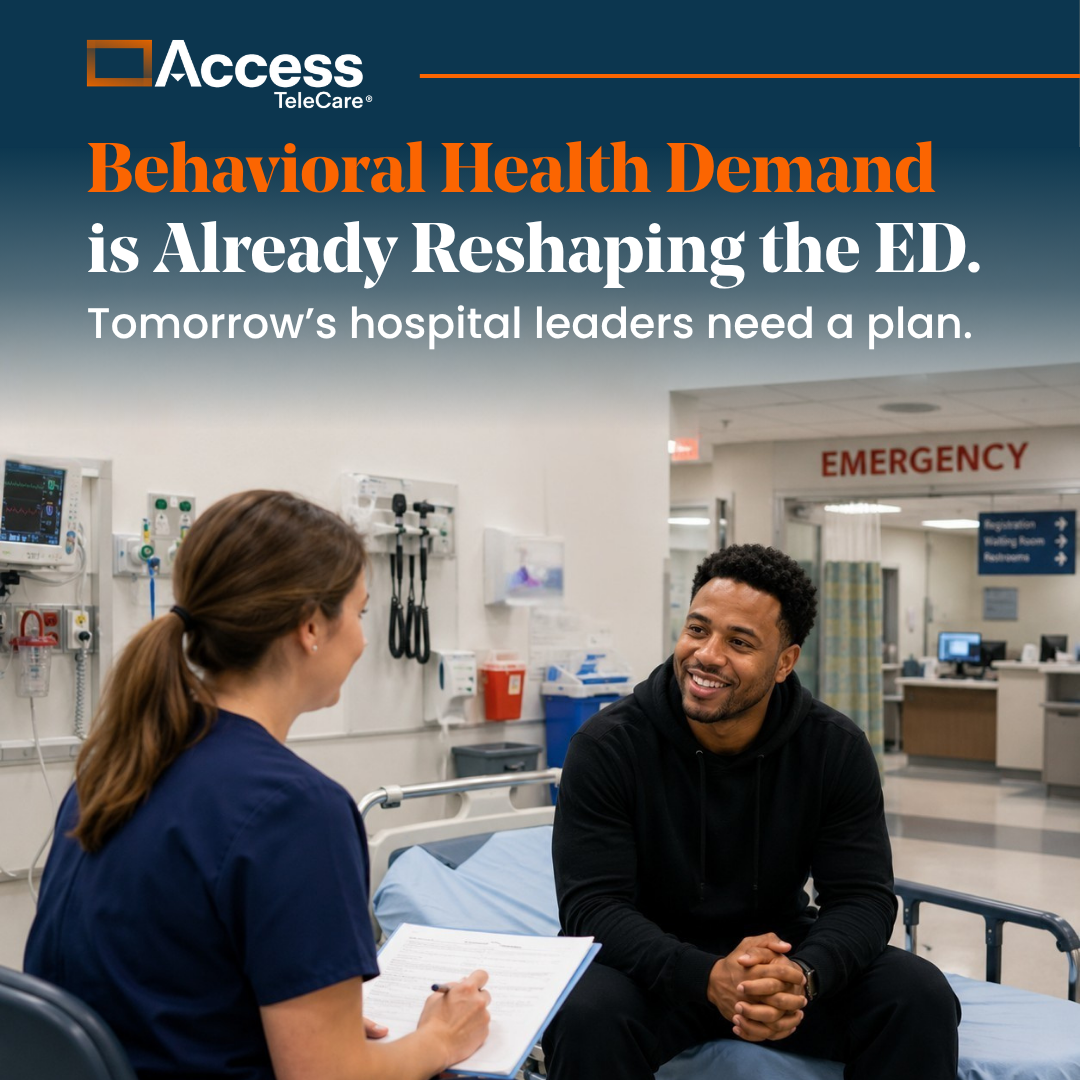
Tomorrow’s Hospital Leaders Are Already Looking at Behavioral Health in the ED
Behavioral health demand is becoming one of the next defining [...]

How Telemedicine Fits Into the Healthcare Affordability Equation
Acute Care Telemedicine, Behavioral Health, Emergency Care, General Telemedicine, Infectious Disease, maternal-fetal medicine, Rural Health Care, teleCardiology, teleEEG, teleEndocrinology, teleHospitalists, teleICU, teleInfectious Disease, teleMaternal-Fetal Medicine, teleNephrology, teleNeurology, telePsychiatry, telePulmonology, teleStroke
How Telemedicine Fits Into the Healthcare Affordability Equation
By Chris Gallagher, M.D. Founder and Chief Strategy Officer, Access [...]
Frequently Asked Questions
Access TeleCare delivers psychiatric and behavioral health services via secure, real-time video and digital platforms. In a hospital setting, Access TeleCare deployslicensed world-class providers as an integrated extension of the care team rather thana standalone service. TelePsychiatrists and Advanced Practice Clinicians provideconsults, evaluations, rounding, and follow-up care across the emergency department, inpatient units, behavioral health hospitals, and outpatient settings. Access is typicallyenabled through telemedicine carts or secure software embedded within the hospital’sexisting workflows and EMR, allowing bedside staff to connect patients to a specialiston demand or through scheduled coverage.
Access TeleCare’s behavioral health services mitigate workforce shortages by givinghospitals access to a distributed network of board-certified psychiatrists and APCswithout the need to recruit locally. This is especially critical in rural and underservedareas where psychiatric coverage is limited or nonexistent. It also allows hospitals toextend coverage beyond traditional hours, reduce clinician burnout, and stabilizeservice lines that would otherwise be constrained by staffinggaps.
Access TeleCare’s teleBehavioral Health services improve ED throughput by significantly reducing wait times for psychiatric evaluation and disposition. Faster access to a specialist enables quicker clinical decision-making, whether that is admission, discharge, or transfer. This dramatically reduces boarding time sand length of stay for behavioral health patients, frees up ED beds, and improves overall patient flow. Here’s an example case study where length of stay for BH patients was reduced by 70%. On the inpatient side, timely consults and ongoing psychiatric management can contribute to shorter lengths of stay by accelerating treatment planning and discharge readiness.
TeleBehavioral Health programs follow established regulatory and accreditation standards, including The Joint Commission and others. They support compliance by ensuring timely access to qualified specialists, standardized documentation within the EMR, and consistent clinical protocols across care settings. Many programs also incorporate quality monitoring, peer review, and performance analytics to track outcomes and maintain high standards of care delivery.
Successful teleBehavioral Health programs integrate directly into the hospital’s existing infrastructure. This typically includes EMR integration for documentation and order entry, alignment with clinical workflows, and secure connectivity that meets HIPAA requirements. Hardware may include telemedicine carts or in-room devices, but many programs can also operate through software-based solutions. Just as important is operational integration—ensuring virtual clinicians are embedded into care teams, participate in rounds, and follow hospital-specific protocols.
Access TeleCare’s teleBehavioral Health improves patient satisfaction by reducing wait times, increasing access to care, and allowing patients to receive treatment in a familiar, local setting. Patients are more likely to engage in care when services are timely and coordinated. Clinically, earlier intervention and consistent follow-up contribute to better outcomes, reduced readmissions, and improved continuity of care across the behavioral health continuum.
- Key use cases span the full continuum of care, including:
- Emergency department psychiatric evaluations for rapid assessment and disposition
- Inpatient consults and rounding to support ongoing behavioral health management
- Crisis stabilization and risk assessments, including suicide evaluations
- Medication management and treatment planning
- Discharge planning and care coordination to ensure continuity post-hospitalization
- Outpatient follow-up visits to maintain engagement in care